
Buprenorphine Ceiling Effect Simulator
Safety Factors
Legend:
If you are taking buprenorphine or considering it for opioid use disorder (OUD), one question usually dominates your mind: is it safe? The short answer is yes, but with a crucial caveat that involves understanding how this medication behaves differently from other opioids. Unlike heroin, morphine, or even methadone, buprenorphine has a built-in safety mechanism known as the "ceiling effect." This pharmacological feature limits the drug's impact on your breathing at higher doses, drastically reducing the risk of fatal respiratory depression-the primary cause of opioid overdoses.
However, safety does not mean the absence of side effects. While buprenorphine is significantly safer than full opioid agonists, it still interacts powerfully with your brain’s reward system. It can cause withdrawal symptoms if started incorrectly, lead to constipation, headaches, and sedation, and carries a serious risk when mixed with other central nervous system depressants like benzodiazepines. To use this life-saving medication effectively, you need to understand not just what it does, but why its unique chemical structure changes the rules of engagement compared to traditional painkillers or illicit opioids.
The Ceiling Effect: A Built-In Safety Brake
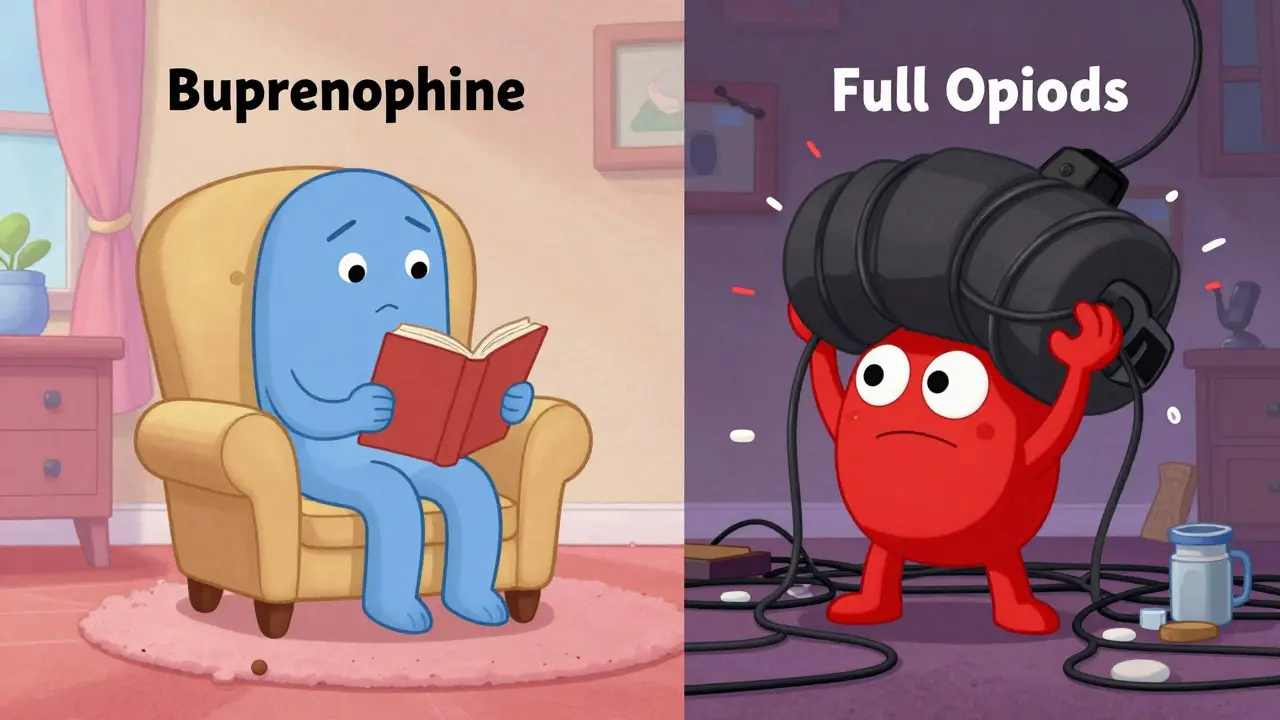
The defining characteristic of buprenorphine is its status as a partial mu-opioid receptor agonist. To understand what this means for your daily life, imagine your body’s opioid receptors are light switches. Full agonists like oxycodone or heroin turn these switches all the way up to maximum brightness. You can keep adding more drug, and the "brightness"-or in medical terms, respiratory depression and euphoria-keeps increasing until it becomes dangerous or fatal.
Buprenorphine works differently. It turns the switch on, but only partially. Once you reach a certain dose, typically around 8 to 16 milligrams for most people, the receptors are fully occupied by the buprenorphine molecules. Adding more medication does not increase the effect because there are no empty receptors left to bind to. This plateau is the "ceiling effect." According to clinical data from the Substance Abuse and Mental Health Services Administration (SAMHSA), further increases above 24 mg per day do not increase effects on respiratory or cardiovascular function. This is why buprenorphine overdose deaths are far less common than those involving full agonists, provided the drug is taken alone.
This endpoint-specific ceiling is critical. While the risk of stopping breathing hits a ceiling, the pain-relieving properties (analgesia) and craving reduction may continue to improve slightly with higher doses, though the margin of benefit diminishes. This allows doctors to prescribe doses high enough to block cravings without pushing patients into the coma-inducing territory associated with full opioids.
Common Side Effects vs. Dangerous Risks
When starting buprenorphine, your body undergoes significant adjustment. Most side effects are manageable and tend to fade as your system stabilizes, but knowing what to expect helps prevent unnecessary panic or discontinuation. Here is a breakdown of the most frequent issues reported in clinical trials and patient communities:
- Precipitated Withdrawal: This is the most feared initial side effect. If you take buprenorphine while other full opioids are still active in your system, its high affinity kicks them off the receptors instantly but doesn't replace their full effect immediately. This triggers sudden, severe withdrawal. Clinical data suggests this occurs in about 25% of improper inductions. To avoid this, you must wait until you are in mild-to-moderate withdrawal before your first dose.
- Headaches: Reported by approximately 18% of patients in Phase III trials, these often resolve within the first few weeks as tolerance builds.
- Constipation: Affecting roughly 12% of users, this is a lingering issue for many. Unlike nausea, constipation often does not go away with time, requiring dietary adjustments or laxatives.
- Sedation and Dizziness: While less sedating than methadone, some patients report feeling "foggy" or tired, especially during the titration phase when doses are being increased.
- Mouth Ulcers: With sublingual films or tablets, prolonged contact with the mouth can cause sores. Rotating the placement under the tongue or using buccal (cheek) administration can help.
It is worth noting that approximately 70-80% of patients report reduced cravings within 30-60 minutes of dosing, which often outweighs the discomfort of minor side effects. However, about 15-20% of patients experience persistent withdrawal symptoms even at standard doses, indicating they may require dose adjustments or alternative treatments.
Buprenorphine vs. Methadone: A Safety Comparison
In the landscape of Medication-Assisted Treatment (MAT), buprenorphine is often compared directly to methadone. Both are effective, but their safety profiles differ markedly due to their pharmacological mechanisms. Methadone is a full mu-opioid agonist with a long half-life, meaning it stays in your system for a long time and accumulates if doses are too high. This accumulation creates a narrow therapeutic window where the difference between a helpful dose and a lethal one can be small.
| Feature | Buprenorphine | Methadone |
|---|---|---|
| Receptor Action | Partial Agonist (Ceiling Effect) | Full Agonist (No Ceiling) |
| Respiratory Depression Risk | Low at therapeutic doses | Higher, especially with accumulation |
| Dosing Frequency | Once daily or every other day | Usually once daily, requires clinic visits |
| Overdose Potential (Alone) | Significantly lower | Higher |
| Induction Process | Risk of precipitated withdrawal | Risk of acute intoxication |
Buprenorphine’s high affinity for mu-opioid receptors-approximately 25 to 50 times greater than morphine-means it binds tightly and stays bound. This slow dissociation rate (half-life of receptor binding is about 6-8 hours) allows for flexible dosing schedules, including once-daily or even three-times-weekly maintenance. For many patients, this flexibility translates to better functionality. As one user noted in recovery forums, "I can take my 16mg and go to work without feeling like I'm on something, which methadone never allowed." This ability to maintain normalcy is a significant psychological benefit in long-term recovery.
The Hidden Danger: Polydrug Use
While the ceiling effect protects against respiratory depression from buprenorphine alone, it does not make you invincible. The greatest threat to safety remains the combination of buprenorphine with other central nervous system (CNS) depressants, particularly benzodiazepines (like Xanax, Valium, or Klonopin) and alcohol.
A 2022 study published in the Journal of Addiction Medicine documented 18 fatal buprenorphine overdoses in the U.S. between 2019 and 2021. In every single case, the overdose involved combinations with benzodiazepines or other CNS depressants. These substances attack the brain’s respiratory drive through different pathways than opioids. When combined, their effects are synergistic, meaning the total suppression of breathing is greater than the sum of the individual drugs. The ceiling effect of buprenorphine cannot counteract the respiratory suppression caused by a heavy dose of benzodiazepines.
This reality underscores a critical rule: never mix buprenorphine with alcohol, benzos, or sleep aids unless explicitly monitored by a healthcare provider who understands the risks. The safety profile of buprenorphine is robust against itself, but fragile in the presence of other depressants.

Dosing Strategies and Titration
Finding the right dose is a balancing act. Too little, and you remain in withdrawal or vulnerable to cravings; too much, and you face unnecessary side effects without added benefit. Standard clinical protocols recommend starting with 2-4 mg sublingually and titrating upward by 2-4 mg every two hours to a maximum of 16 mg on the first day. Most patients stabilize between 8-16 mg daily.
However, individual needs vary. Research from the MCSTAP network indicates that patients with co-occurring chronic pain may require higher buprenorphine doses to achieve adequate pain relief and opioid blockade. Some individuals may need up to 24 mg to fully saturate their receptors and eliminate cravings. This is not "overdosing" in the traditional sense; it is reaching the therapeutic ceiling. Dr. Walter Ling, a leading expert in addiction medicine, emphasizes that the ceiling effect should not be misinterpreted as "partial efficacy." Depending on the endpoint-whether it’s blocking heroin’s high or relieving pain-the dose-response curve behaves differently.
Newer formulations, such as weekly injections (Sublocade), aim to simplify this process by maintaining stable blood levels and eliminating the peaks and valleys associated with daily sublingual dosing. Clinical trials show that 49% of patients on weekly injections achieved 26 weeks of continuous abstinence, compared to 35% on daily sublingual forms. This stability can reduce the temptation to misuse other substances during periods of low drug concentration.
Long-Term Outlook and Future Developments
Buprenorphine has become a cornerstone of OUD treatment, representing approximately 50% of all medication-assisted treatment prescriptions in the U.S. as of 2022. Its safety profile, combined with the ability to prescribe it in office-based settings rather than specialized clinics, has expanded access to care significantly. The global market for buprenorphine is projected to grow, reflecting increased awareness of its advantages over older therapies.
Looking ahead, research is focused on enhancing bioavailability and creating pro-drug combinations that maintain the safety ceiling while improving efficacy for treatment-resistant patients. For now, the evidence is clear: buprenorphine offers a viable path out of opioid dependence with a significantly reduced risk of fatal overdose, provided it is used correctly and not mixed with other depressants. Understanding the ceiling effect empowers you to trust the medication’s safety limits while remaining vigilant about its interactions and side effects.
What is the ceiling effect of buprenorphine?
The ceiling effect refers to the point at which increasing the dose of buprenorphine no longer produces proportional increases in certain effects, particularly respiratory depression. Because buprenorphine is a partial opioid agonist, it only activates opioid receptors to a limited extent. Once the receptors are saturated (usually at doses above 8-16 mg), adding more drug does not increase the risk of stopping breathing, unlike full opioid agonists where higher doses linearly increase overdose risk.
Can you overdose on buprenorphine?
Yes, but it is significantly less common than with full opioids when taken alone. The ceiling effect makes fatal respiratory depression rare from buprenorphine monotherapy. However, overdose risk increases dramatically when buprenorphine is combined with other central nervous system depressants like benzodiazepines, alcohol, or sedatives. All documented buprenorphine-related fatalities in recent studies involved polydrug use.
What are the most common side effects of buprenorphine?
Common side effects include headaches (reported by ~18% of patients), constipation (~12%), nausea, dizziness, and sedation. A major initial risk is precipitated withdrawal, which occurs if buprenorphine is taken too soon after using full opioids. This happens because buprenorphine displaces other opioids from receptors but provides less activation initially, triggering sudden withdrawal symptoms.
Is buprenorphine safer than methadone?
Generally, yes, regarding overdose risk. Methadone is a full opioid agonist with no ceiling effect, meaning higher doses can lead to fatal respiratory depression. Buprenorphine’s partial agonist nature limits this risk. Additionally, buprenorphine can be prescribed in office-based settings, offering more flexibility than methadone, which typically requires daily clinic visits. However, methadone may be more effective for some patients with severe opioid dependence who require higher receptor occupancy.
How do I avoid precipitated withdrawal when starting buprenorphine?
To avoid precipitated withdrawal, you must wait until you are in mild-to-moderate withdrawal from your last opioid use before taking your first dose of buprenorphine. This ensures that other opioids have cleared your system enough that buprenorphine can safely bind to the receptors without kicking them off abruptly. Healthcare providers often use the Clinical Opiate Withdrawal Scale (COWS) to determine the right timing.