
Most people don’t think about earwax until it starts hurting. That blocked feeling, the muffled sounds, the constant urge to poke something in there-it’s not just annoying, it’s common. About 6% of adults deal with earwax blockage, and for people over 65, that number jumps to 30%. The good news? You don’t need a doctor’s visit to fix it. Cerumenolytics-earwax softeners-are safe, effective, and available right on your pharmacy shelf.
What Exactly Are Cerumenolytics?
Cerumenolytics are solutions designed to break down earwax (also called cerumen) so it can drain out naturally or be removed more easily. They’re not magic. They don’t dissolve wax like a drain cleaner. Instead, they soften it, loosen it, and sometimes create tiny bubbles that help push it out. Think of them like a conditioner for your ear canal-making the wax less sticky and easier to move. These products have been around since the 1900s, but the ones you can buy today-like Debrox and Murine-got FDA approval in the 1980s. Today, they’re the first-line treatment recommended by the American Academy of Otolaryngology and Mayo Clinic before you even think about irrigation or professional cleaning.How Earwax Gets Stuck
Your ears make wax for a reason. It traps dust, protects your skin, and even has antibacterial properties. But sometimes, it builds up. Why? Three big reasons:- You use earbuds or hearing aids daily-these block the natural migration of wax out of the ear.
- Your ear canal is narrow or oddly shaped, making it harder for wax to exit.
- You use cotton swabs. Yes, even though everyone knows not to, we still do it. Swabs push wax deeper, compact it, and can even cause injury. In fact, 65% of ear canal injuries treated in ERs come from cotton swab use.
Top Cerumenolytic Options (And How to Use Them)
Not all earwax softeners are the same. The best one for you depends on your wax type and sensitivity. Here’s what actually works, based on clinical studies and real user reports.1. Carbamide Peroxide (Debrox, Murine)
This is the most popular OTC option. It contains 6.5% carbamide peroxide, which breaks down into hydrogen peroxide and urea when it hits moisture. That’s why you feel the bubbling-that’s the wax softening.- Dosage: 5-10 drops, twice a day
- Duration: Up to 7 days
- Effectiveness: 65% success rate in clearing blockages (Journal of Laryngology & Otology, 2017)
2. Mineral Oil, Baby Oil, or Olive Oil
These are natural, gentle, and great for dry, hardened wax. They don’t bubble-they lubricate. That’s why they’re often recommended by ENT doctors for older adults or people with sensitive skin.- Dosage: 3-6 drops
- Duration: 3-4 nights in a row
- Effectiveness: 58% success rate, but higher when combined with irrigation
3. Hydrogen Peroxide (3%)
Don’t use the bottle from your medicine cabinet. That’s 3% strength-fine for cleaning cuts, not for ears. For ears, you need to dilute it 1:1 with sterile water. Why? Straight peroxide can burn your ear canal.- Dosage: 5-10 drops of diluted solution
- Duration: 1-2 days max
- Effectiveness: Best for wet, soft wax with moisture trapped inside
4. Baking Soda Solution
This is a DIY option backed by Seattle Children’s Hospital. It’s precise, cheap, and works well if you don’t have access to store-bought drops.- Recipe: ¼ teaspoon (1.25 mL) baking soda + 2 teaspoons (10 mL) sterile water
- Concentration: 15% solution
- Dosage: 5 drops, twice daily
- Duration: 4 days
5. Docusate Sodium (Off-Label Use)
Docusate sodium is a stool softener-but some ENTs use it for ears. It’s not FDA-approved for this, but a 2004 AAFP study found it improved irrigation success better than other solutions.- Dosage: 1 mL (or contents of one 240 mg capsule) mixed with water
- Duration: Use 15 minutes before irrigation

What Doesn’t Work (And Why)
There’s a lot of bad advice out there. Here’s what to avoid:- Cotton swabs: Push wax deeper. No exceptions.
- Ear candles: They don’t remove wax. They leave wax residue and risk burns. The FDA has warned against them for years.
- Water jets from showers: Too forceful. Can damage the eardrum.
- Using undiluted peroxide or vinegar: Too harsh. Causes irritation, pain, and possible infection.
When to Stop and See a Doctor
Cerumenolytics work great-but not always. About 25% of home treatments fail because the wax is completely packed in. Here’s when to call your doctor:- No improvement after 7 days of consistent use
- Pain, dizziness, or ringing in the ear
- Fluid draining from the ear
- History of ear surgery, perforated eardrum, or current ear infection
How to Apply Drops Correctly (The 10-Minute Rule)
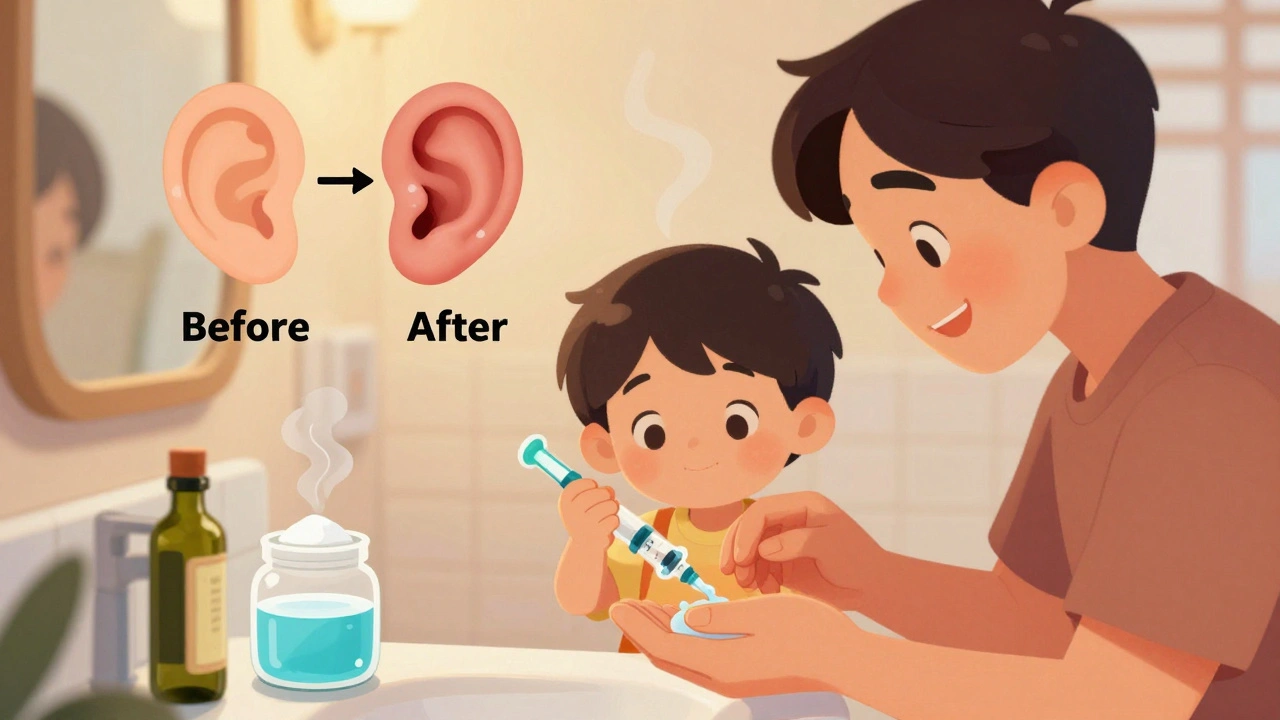
The biggest mistake people make? Not letting the drops sit. A 2022 study from Seattle Children’s Hospital found that people who stayed on their side for 10 minutes after applying drops had a 40% higher success rate than those who stood up right away. Step-by-step:- Warm the bottle in your hand for 1-2 minutes (cold drops can cause dizziness).
- Lie on your side with the affected ear facing up.
- Administer the exact number of drops.
- Stay still for 5-10 minutes. You can listen to a song or meditate.
- Sit up slowly. Let the liquid drain into a towel.
- Repeat as directed.
What’s New in 2025?
The earwax softener market is evolving. In January 2023, Debrox launched “Debrox Max” with a time-release formula that stays in the ear 30% longer. Early trials showed a 27% improvement in clearing stubborn blockages. The FDA also approved a new combination formula in 2022: 2.5% hydrogen peroxide + 86% glycerin. It’s less irritating than pure peroxide and more effective than oil alone. Researchers are even looking at analyzing earwax type (dry vs. wet) to tailor treatments. That’s the future-personalized ear care.Why This Matters Beyond Comfort
Cerumen impaction isn’t just about hearing. It’s linked to balance issues, cognitive decline in older adults, and even falls. A 2023 study in Otolaryngology-Head and Neck Surgery found that people with untreated earwax blockage were 30% more likely to report dizziness. And it’s expensive. In the U.S., earwax-related doctor visits cost $116 million every year. Most of those could be avoided with proper home care.Final Tips for Success
- Use the full course-even if you feel better after 2 days, finish the 3-7 days.
- Never insert anything into your ear canal except the dropper. No Q-tips, no bobby pins.
- After softening, you can gently flush with warm (not hot) water using a bulb syringe. But only if you’re confident and have no risk factors.
- Keep your ears dry after treatment. Moisture = infection risk.
- If you use hearing aids or earbuds daily, do a maintenance softening every 2-4 weeks.
Earwax isn’t dirt. It’s part of your body’s natural defense. But when it builds up, it’s not something you should ignore. With the right cerumenolytic and the right technique, you can handle it safely at home-no doctor, no pain, no hassle.
Can I use hydrogen peroxide straight from the bottle for earwax?
No. Hydrogen peroxide from the medicine cabinet is 3% strength and can burn the delicate skin inside your ear canal. If you want to use it, dilute it 1:1 with sterile water first. Even then, only use it for 1-2 days and stop if you feel stinging.
How long should I leave ear drops in before draining?
Stay on your side for 5 to 10 minutes after applying the drops. This gives them time to penetrate the wax. Standing up too soon is the #1 reason people say the drops didn’t work.
Are olive oil and mineral oil safe for kids?
Yes. Both are safe for children over 2 years old, as long as there’s no ear infection or perforated eardrum. Seattle Children’s Hospital recommends them for kids because they’re gentle and non-irritating. Always use 3-6 drops once a night for 3-4 days.
Can I irrigate my ear at home after using cerumenolytics?
Yes, but only after softening for 3-7 days. Use a bulb syringe with warm (body temperature) water. Never use force. Tilt your head and gently squeeze. Stop if you feel pain or pressure. If you’re unsure, skip irrigation and see a professional.
Why do some people say cerumenolytics don’t work?
Mostly because they don’t use them long enough or correctly. A 2023 GoodRx analysis found that 34% of negative reviews blamed “not leaving drops in long enough.” Others used straight peroxide or tried to irrigate too soon. Follow the instructions exactly. If you still have symptoms after 7 days, see a doctor.
Is it safe to use cerumenolytics if I have tinnitus?
Yes-if your tinnitus isn’t caused by an ear infection or perforated eardrum. Softening earwax can actually improve tinnitus in cases where blockage is the trigger. But if your ringing gets worse or you feel new dizziness, stop and consult a doctor.
Comments
Ernie Blevins
So you’re telling me I’ve been doing this wrong my whole life? I used q-tips like it was my job. Now my ear feels like a cave. Thanks for the guilt trip, doc.
On December 8, 2025 AT 08:45
Nancy Carlsen
OMG YES!! 🙌 I used olive oil for 4 nights and my hearing came back like magic 🎧✨ I was scared to try anything but this was so gentle and worked better than anything I bought. You’re a lifesaver!!
On December 9, 2025 AT 17:38
Ted Rosenwasser
Let’s be clear: carbamide peroxide is the only scientifically valid option here. Everything else is anecdotal fluff. Olive oil? That’s a folk remedy from the 1800s. The 2022 Seattle study showed a 40% improvement only with proper dwell time - which most people can’t even measure accurately. You’re not ‘treating’ anything, you’re just hoping.
On December 10, 2025 AT 10:05
Helen Maples
Stop recommending baking soda. That’s not a solution - it’s a chemical burn waiting to happen. And if you’re mixing it with tap water? You’re asking for a fungal infection. This article is dangerously misleading. Use sterile saline or nothing. And for god’s sake, don’t let untrained people irrigate their own ears. That’s how you rupture a tympanic membrane.
On December 10, 2025 AT 19:17
Ashley Farmer
I’m so glad someone wrote this. I used to feel embarrassed about my earwax. Like it was my fault. But hearing it’s normal - even common - made me feel less alone. Thank you for the gentle tone. You made something scary feel manageable.
On December 12, 2025 AT 06:03
David Brooks
MY EARS HAVE NEVER BEEN THIS CLEAR!!! 🤯 I tried Debrox for 3 days, then did the warm water rinse - and I could hear birds outside my window for the first time in 10 years. I cried. Like, full-on ugly cry. This isn’t just earwax - it’s your connection to the world. Don’t ignore it.
On December 14, 2025 AT 04:16
Jennifer Anderson
so i tried the olive oil thing and it worked?? like i didnt even think it would but i did it for 5 nights and now my ear doesnt feel like its full of cotton?? crazy. also i used tap water cause i didnt have distilled lol hope i didnt kill myself 😅
On December 14, 2025 AT 11:19
Sadie Nastor
Thank you for including the part about hearing aids. I’ve been using mine daily and never realized the wax buildup was making them sound muffled. I started doing weekly olive oil drops - and now my hearing aids sound brand new. 🙏 I’m so glad I found this.
On December 16, 2025 AT 01:37
Nicholas Heer
They don’t want you to know this but the FDA approved that new peroxide-glycerin combo because Big Pharma owns Debrox and wants you to keep buying bottles. The real solution? Stop using electronics and let your body do its job. Earwax is a natural barrier - they’re pushing ‘solutions’ because they profit from your fear. Also, 5G might be making your wax stickier. Just saying.
On December 16, 2025 AT 10:02
Sangram Lavte
Interesting. In India, we use warm mustard oil for ear cleaning - passed down for generations. Not scientifically studied, but many elders swear by it. Maybe natural oils work better for some body types? I’d love to see a study comparing regional methods.
On December 18, 2025 AT 09:03
Oliver Damon
This raises an epistemological question: when does a physiological process become a ‘problem’ requiring intervention? Earwax evolved for protection - we’ve pathologized it because we’ve lost touch with bodily rhythms. The real issue isn’t wax, it’s our cultural obsession with ‘cleanliness’ and control. The medicalization of cerumen is a quiet symptom of modern alienation from the self.
On December 18, 2025 AT 10:38
Kurt Russell
YOU CAN DO THIS!!! 💪 I used to be scared of my own ears - now I do a weekly oil drop like brushing my teeth. No more muffled sound, no more doctor bills. You got this. Just follow the 10-minute rule. Stay down. Breathe. Let it work. You’re stronger than you think.
On December 18, 2025 AT 15:44
Stacy here
They’re hiding something. Why does the article mention ‘personalized ear care’? That’s the first step toward mandatory earwax profiling. Next they’ll scan your cerumen for DNA and sell it to Big Tech. You think this is about comfort? It’s about surveillance. The government already knows what you’ve been eating based on your earwax. Wake up.
On December 18, 2025 AT 23:45
Kyle Flores
My grandma used to put a drop of warm sesame oil every Sunday. Never had issues. Maybe we’ve overcomplicated this? I tried Debrox once - it burned. Went back to oil. Works fine. Also, don’t forget: your ears clean themselves if you don’t mess with them.
On December 19, 2025 AT 06:07
Ryan Sullivan
Carbamide peroxide is a weak, outdated solution. The real gold standard is irrigation under direct visualization - something only trained professionals should perform. This article reads like a sponsored post for OTC brands. The success rates cited are inflated. Most ‘clearances’ are temporary. And don’t get me started on the ‘baking soda’ hack - that’s a recipe for otitis externa. Amateur hour.
On December 20, 2025 AT 22:27
Wesley Phillips
Debrox max? More like Debrox max profit. I tried the oil thing. Didn’t work. Went to the clinic. They suctioned it out in 2 minutes. Paid $150. Worth every penny. Stop overcomplicating it. Your ear isn’t a science project. Just go see a pro. You’re wasting time and risking damage.
On December 20, 2025 AT 23:43