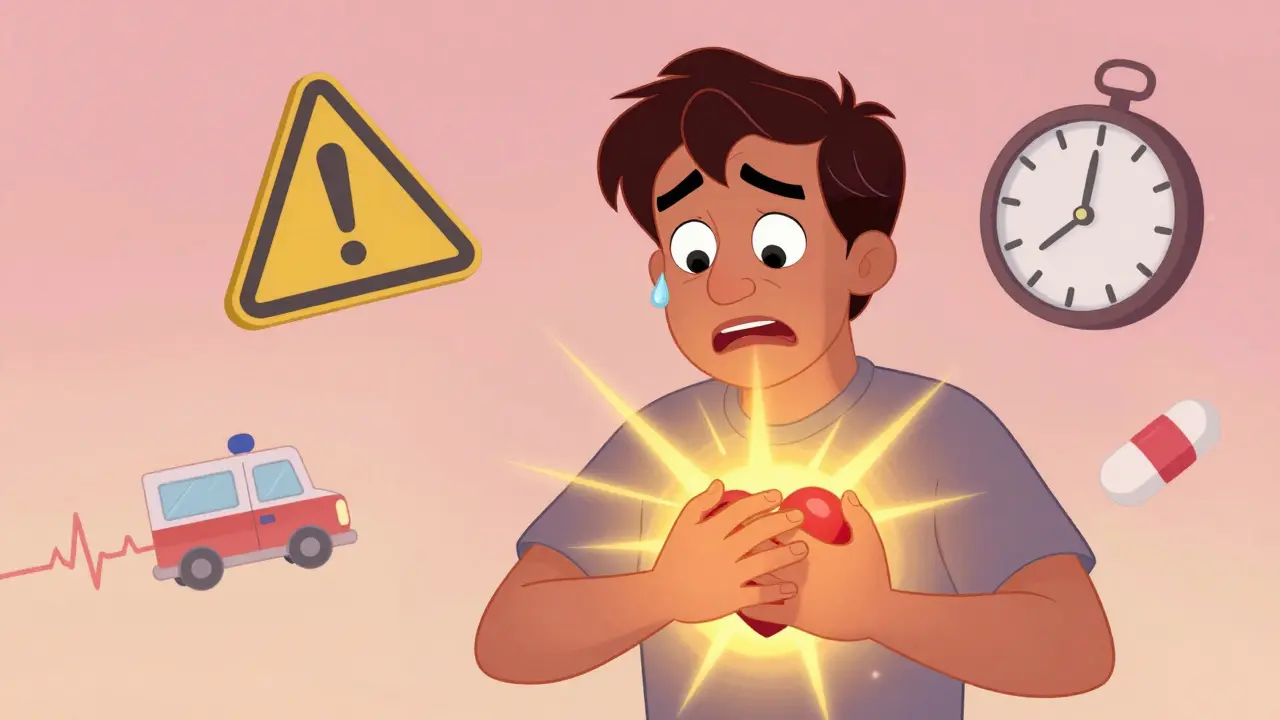
When your chest hurts, your mind races. Is it heartburn? A pulled muscle? Or something deadly? Chest pain isn’t just a sharp stab under your ribs-it can feel like pressure, tightness, or a heavy weight. It might spread to your jaw, arm, or back. You might feel sweaty, short of breath, or suddenly exhausted. These aren’t just symptoms-they’re warning signs that could mean your heart is in trouble.
Every year in the U.S., over 6 million people show up at emergency departments with chest pain. Only about 1 in 8 will have a heart attack. But missing the other 7? That’s where lives are lost. The key isn’t to panic-it’s to know when to act fast.
What Chest Pain Really Means
Chest pain isn’t always about the heart. It can come from your lungs, stomach, muscles, or even anxiety. But when it’s your heart, the clock starts ticking the moment the pain begins. The 2021 American Heart Association and American College of Cardiology guidelines define chest pain broadly: it’s not just pain. It’s pressure, squeezing, burning, or discomfort in your chest, shoulders, arms, neck, jaw, or upper belly. And it often comes with other signs-sweating, nausea, dizziness, or trouble breathing.
Many people think heart attacks always feel like a movie scene-clutching the chest, collapsing. But that’s not the full picture. Women, older adults, and people with diabetes often have subtler symptoms: extreme fatigue, indigestion, or just a strange feeling that something’s wrong. Don’t wait for the classic signs. If you feel off, especially with any chest discomfort, take it seriously.
When to Call 999 (or 911) Right Away
Don’t drive yourself. Don’t wait to see if it gets better. If you’re having chest pain and any of these, call emergency services immediately:
- Pain that lasts more than 10 minutes and doesn’t go away with rest
- Pain that spreads to your arm, jaw, neck, or back
- Breaking out in a cold sweat for no reason
- Feeling dizzy, lightheaded, or about to pass out
- Shortness of breath with no clear cause
- Nausea or vomiting with chest discomfort
- Heart rate over 100 beats per minute with no exertion
- Low blood pressure (below 90 systolic)
- Unexplained fatigue that feels completely out of character
These aren’t guesses. These are the clinical red flags doctors use to spot life-threatening conditions like heart attacks, aortic dissections, or pulmonary embolisms. The 2021 AHA/ACC guideline says if you have any of these, you need emergency care-no exceptions.
Why Ambulance Over a Car?
Some people think driving to the hospital is faster. It’s not. And it’s riskier. Studies show that patients who drive themselves to the ER have a 25-30% higher chance of complications than those transported by ambulance.
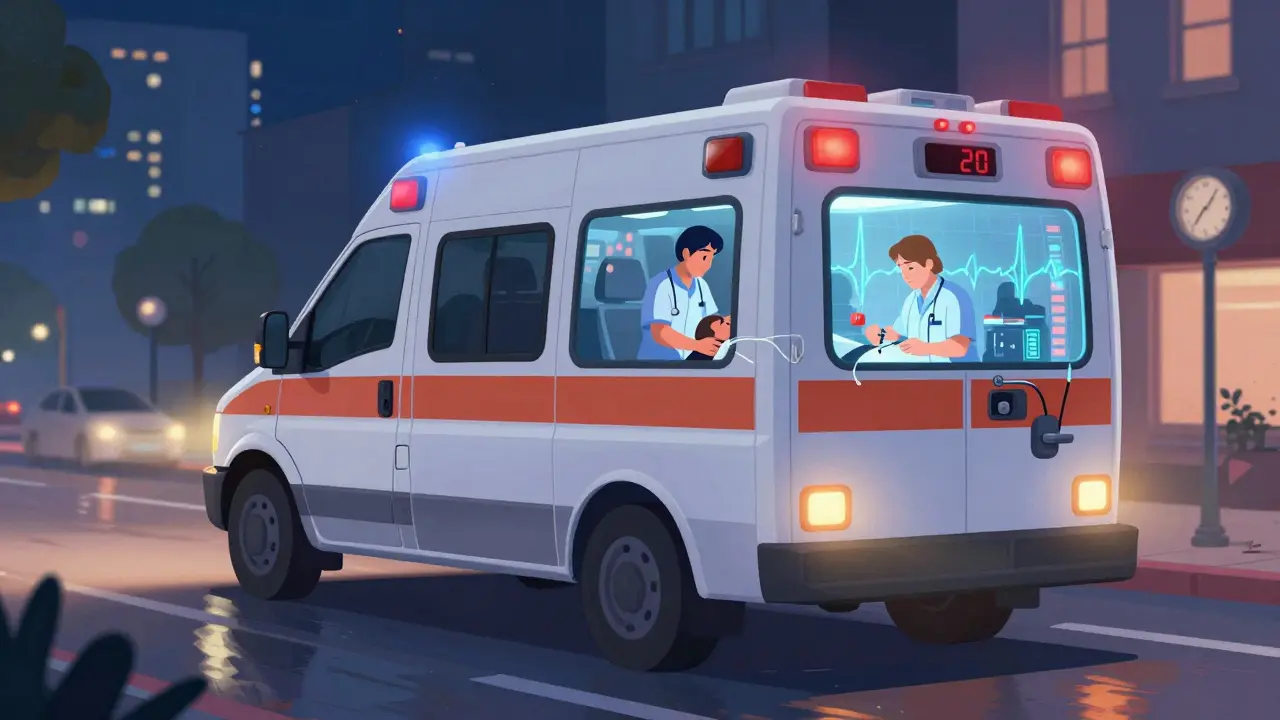
Why? Ambulances start treatment before you even get to the hospital. Paramedics can do a 12-lead ECG in your driveway. They can give aspirin. They can alert the hospital that a heart attack patient is coming. By the time you arrive, the cath lab team is already waiting. That’s the difference between life and death.
That ECG? It needs to be done within 10 minutes of arrival. If you arrive by car, that clock starts when you check in. If you arrive by ambulance, it started 20 minutes ago.
The Role of the ECG and Troponin Test
Once you’re in the ER, two tests decide your next steps: the ECG and a blood test for cardiac troponin.
The ECG is the fastest, cheapest, and most powerful tool doctors have. It shows electrical activity in your heart. If you’re having a heart attack, it often shows clear changes-like ST-segment elevation (STEMI). But even subtle changes matter. The 2021 guideline says doctors should repeat the ECG every 15-30 minutes if pain continues, because some heart attacks don’t show up right away.
The high-sensitivity troponin test checks for heart muscle damage. It’s so sensitive it can detect tiny leaks of protein from stressed heart cells. New protocols use two tests-taken an hour apart-to rule out a heart attack in as little as one hour for many patients. In fact, 70-80% of chest pain patients can be safely sent home within two hours using this method.
But here’s the catch: this only works with modern high-sensitivity assays. If your hospital still uses old troponin tests, the timing and accuracy change. Ask if they use high-sensitivity troponin-it’s now standard in over 90% of U.S. hospitals as of 2022.
When You Can Wait-And When You Can’t
Not every chest ache needs the ER. If your pain:
- Only happens when you exert yourself
- Go away after resting or taking nitroglycerin
- Feels like indigestion and responds to antacids
- Is sharp and localized (like a muscle pull)
- Is triggered by deep breathing or coughing
Then it might be stable angina or something less urgent. But even then, you still need to see your doctor within 24-48 hours. Don’t assume it’s “just gas.”
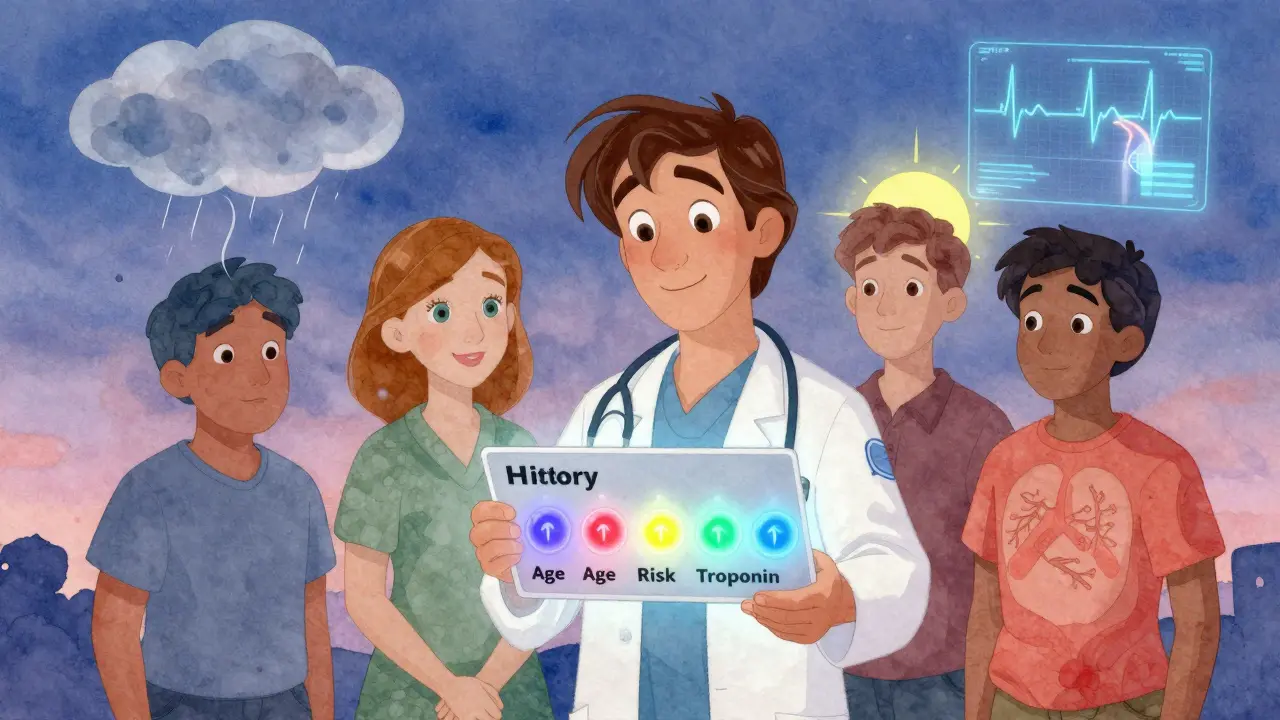
The HEART score helps doctors decide: it looks at your History, ECG, Age, Risk factors, and Troponin level. A score of 0-3? Low risk. You might go home with a follow-up. A score of 7-10? High risk. You’re going straight to the cath lab.
What Happens in the Emergency Department
If you’re high-risk, you’ll get immediate care: oxygen, aspirin, nitroglycerin, and an ECG. Then you’ll likely go for a coronary angiogram-a procedure where doctors thread a catheter into your heart to find blocked arteries. If they find one, they’ll open it with a stent. The goal? Door-to-balloon time under 90 minutes. That’s the national standard for STEMI patients.
If you’re intermediate-risk, you might get a CT scan of your heart (CCTA) or a stress test. These help spot narrowing in your arteries without going straight to surgery.
If you’re low-risk? You’ll be sent home with instructions to follow up with your GP or a cardiologist within a week. But don’t ignore it. Even low-risk chest pain can be a sign of INOCA-ischemia with no obstructive coronary arteries. It’s real. It affects 5-10% of people evaluated for chest pain. And it needs attention, even if your arteries look “normal.”
What You Can Do Today
Don’t wait for a crisis to learn this.
- Know your risk factors: high blood pressure, diabetes, smoking, high cholesterol, family history
- Keep aspirin (81mg) in your medicine cabinet-and know how to take it if needed
- Teach your family what chest pain looks like-not just the movie version
- Save emergency numbers on your phone and your parents’ phones
- Don’t dismiss fatigue or indigestion in older adults or women
The best way to survive a heart attack? Recognize it early-and get help immediately. There’s no shame in calling 999 and being wrong. There’s huge risk in waiting and being right too late.
Future of Chest Pain Evaluation
By 2025, most hospitals will use AI to analyze ECGs. These systems can spot tiny changes humans miss-like a slight dip in the ST segment that signals early ischemia. One study showed AI detecting these changes with 98.5% accuracy. That means faster, more precise decisions.
But no algorithm replaces your instincts. If you feel something’s wrong, trust it. Your body knows before your brain can name it.