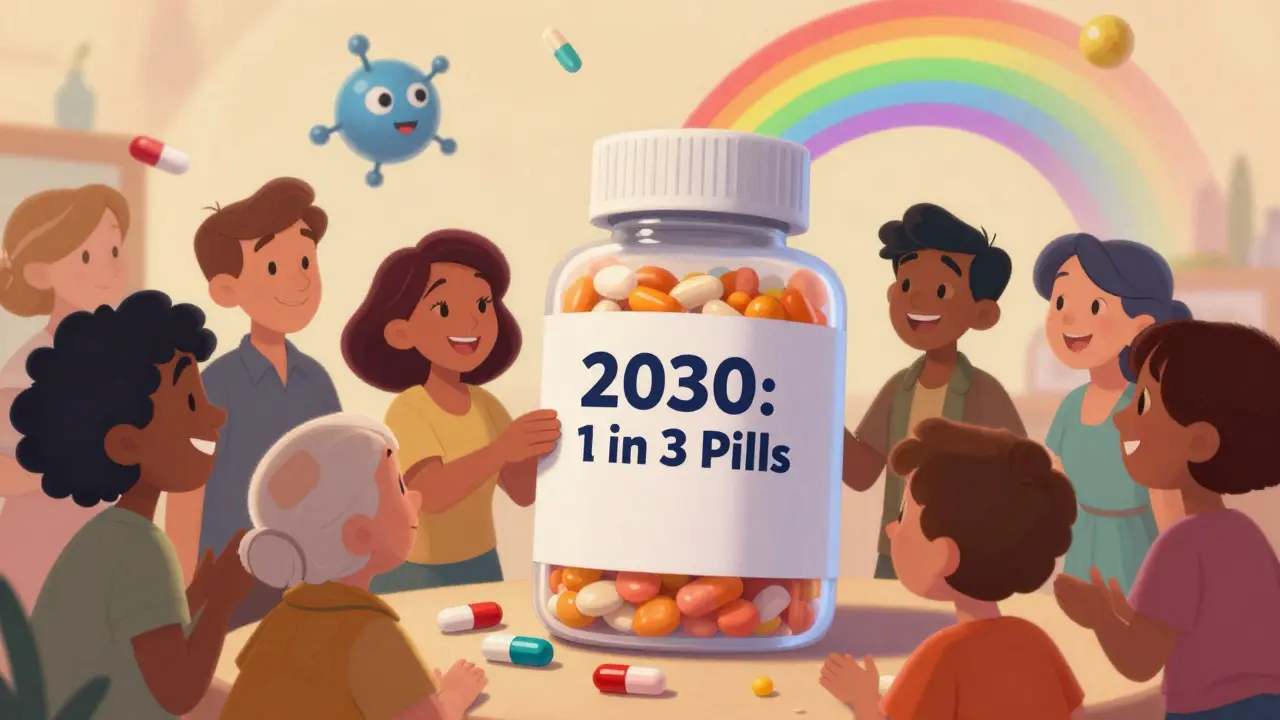
By 2030, nearly one in every three prescription pills sold globally will be a generic version of a drug that once cost ten times more. That’s not a prediction-it’s already happening. In 2024, the global market for generic drugs hit somewhere between $488 billion and $491 billion. By the end of this decade, it could cross $700 billion. This isn’t just about cheaper pills. It’s about reshaping who gets treated, how healthcare systems survive, and who controls the future of medicine.
Why Generics Are Becoming the Default
Generic drugs aren’t knockoffs. They’re exact copies of brand-name drugs, down to the last molecule. The active ingredient, dosage, and how it works in your body are identical. The only difference? Price. A generic version of a drug like atorvastatin (Lipitor) can cost 95% less than the original. That’s why hospitals, insurers, and governments are pushing them harder than ever.
Between 2025 and 2030, over $220 billion in annual sales from top-selling branded drugs will lose patent protection. Think of drugs like Humira, Enbrel, and now newer ones like ustekinumab and vedolizumab. These aren’t minor medications-they treat autoimmune diseases, cancer, and severe inflammation. Once generics enter, prices crash. And with that crash comes a massive shift in how healthcare is paid for.
The Biosimilar Surge
Not all generics are the same. The fastest-growing part of the market isn’t your everyday blood pressure pill. It’s biosimilars-copies of complex biologic drugs made from living cells. These used to be nearly impossible to replicate. Now, thanks to advances in manufacturing and clearer regulatory paths in the EU and Japan, they’re entering the market faster than ever.
Biosimilars are projected to grow at 8.2% annually through 2030, far outpacing traditional generics. Why? Because they’re targeting the most expensive treatments. A single dose of a biologic drug like Dupixent or Skyrizi can cost over $40,000 a year. A biosimilar version could bring that down to $15,000. That’s not just savings-it’s access. Millions of patients who couldn’t afford these drugs before will now get them.
Where the Growth Is Happening
The U.S. and Europe are still the biggest markets for generics, but the real action is in Asia. India alone supplies 20% of the world’s generic drugs and 60% of its vaccines. Chinese manufacturers are doing something even more disruptive: they’re using volume-based procurement to set global prices. When China negotiates bulk deals for a drug, the price drops so low that other countries have no choice but to follow.
India’s strength isn’t just cost-it’s scale. They’ve built entire supply chains around producing high-quality generics at ultra-low prices. China’s power lies in its ability to force price reductions through government procurement. Together, they’re reshaping the global market. Meanwhile, countries like Brazil, Mexico, and South Africa are finally catching up, building regulatory systems to approve more generics and expand access.
Who’s Winning and Who’s Struggling
The big players in the U.S. are Teva, Viatris (which merged Mylan and Pfizer’s generics unit), Sandoz, and Amneal. They’re fighting over shrinking margins. In Europe, Germany and the UK lead in adoption, thanks to strong policies that require doctors to prescribe generics whenever possible.
But the real winners? The manufacturers who’ve invested in complex generics and biosimilars. It takes years and hundreds of millions of dollars to develop a biosimilar. Only companies with deep pockets and technical expertise can enter this space. That’s why the market is becoming more concentrated-not more competitive. Smaller players are getting squeezed out unless they specialize in niche areas like injectables or inhalers.
Technology Is Changing the Game
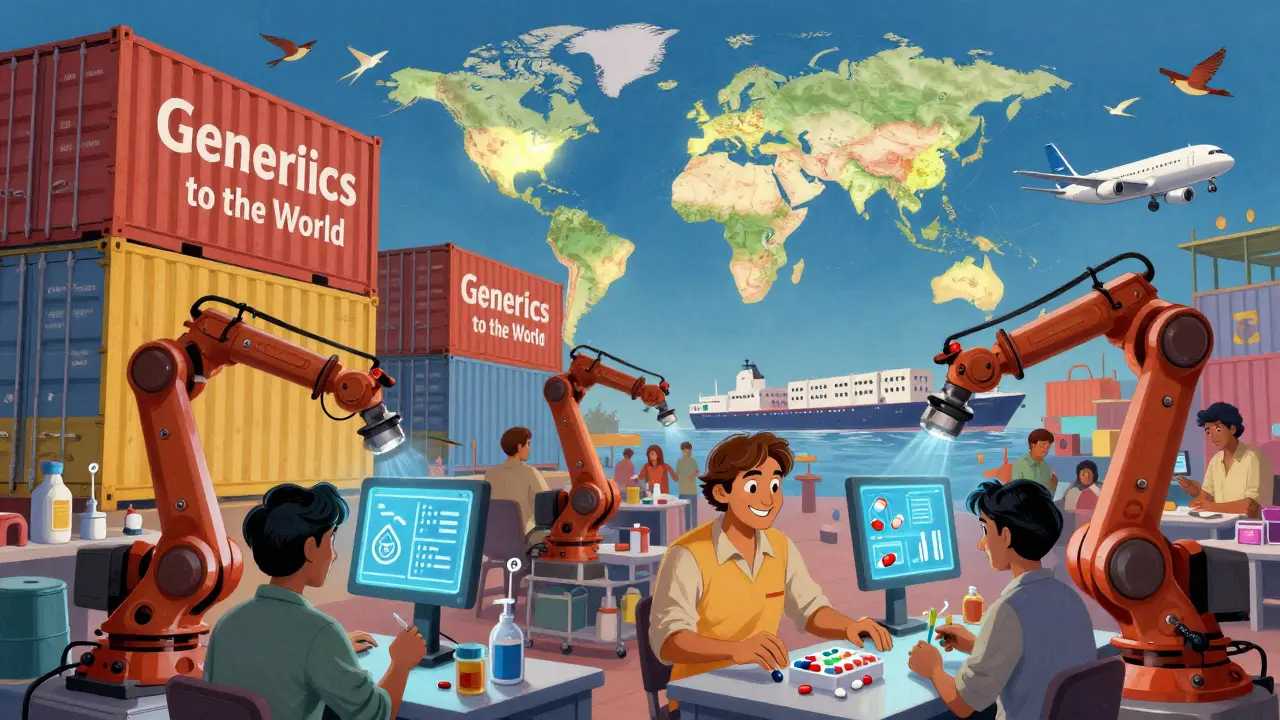
It’s not just about chemistry anymore. Robotic automation in manufacturing, AI-driven quality control, and digital tools that track patient adherence are all boosting efficiency. A company that can automate its production line and reduce defects by 30% gains a massive edge. That’s why some manufacturers are now using real-time data to predict which drugs will have the highest demand next year.
And it’s not just about making pills faster. Tech is helping patients take them. Apps that remind you to refill your diabetes meds, automated pharmacy refill systems, and even smart pill bottles that track when you take your dose-all these tools are making generics more effective. If patients actually take their meds, the whole system works better. That’s a quiet revolution.
The Big Challenges Ahead
There’s a dark side to this growth. As prices fall, profit margins shrink. Some manufacturers are cutting corners. There have been cases of substandard generics in Africa and Latin America, where oversight is weak. Regulatory agencies are scrambling to keep up.
Another issue? Patent litigation. Big pharma is fighting harder than ever to extend exclusivity. They file lawsuits, tweak formulas slightly, or create new delivery methods just to delay generics. These tactics slow down access-and they’re working in some cases. But as more drugs come off patent, even these tricks are running out of steam.
Then there’s the pricing pressure. In markets like the U.S., insurers and pharmacy benefit managers are forcing even lower prices. In Europe, governments are using tender systems that award contracts to the lowest bidder. That means manufacturers are forced to produce more, sell for less, and still make a profit. It’s a tightrope walk.
What’s Next? The Pipeline of Tomorrow
The next wave of generics won’t be for cholesterol or antibiotics. It’ll be for obesity drugs. Semaglutide (Wegovy, Ozempic) and tirzepatide (Mounjaro) are set to lose patent protection between 2028 and 2031. When that happens, the market could explode. These drugs are already generating over $100 billion in annual sales. A generic version at 10% of the price? That’s not just a drug-it’s a public health game-changer.
And it’s not just obesity. Diabetes, hypertension, and mental health drugs are also on the horizon. As populations age and chronic diseases rise, the demand for affordable, long-term treatments will only grow. The generic industry isn’t just reacting to this-it’s preparing for it.
The Bottom Line
The future of generic drugs isn’t about being cheap. It’s about being smart. The companies that succeed will be those that combine manufacturing precision with regulatory savvy, tech integration, and global supply chain flexibility. The patients who benefit will be those who need lifelong treatment but can’t afford the price tags of branded drugs.
By 2030, generic drugs won’t just be a cost-saving option. They’ll be the backbone of affordable healthcare. And if we get this right, millions of people around the world will get the medicines they need-not because they can afford them, but because the system was built to make them accessible.
Are generic drugs as safe as brand-name drugs?
Yes. Generic drugs must meet the same strict standards as brand-name drugs. In the U.S., the FDA requires them to have the same active ingredient, strength, dosage form, and route of administration. They must also prove they’re absorbed in the body at the same rate and extent. Millions of people take generics every day with the same results as the original. The only differences are in inactive ingredients, like color or filler, which don’t affect how the drug works.
Why do generic drugs cost so much less?
Brand-name drug companies spend years and billions developing a drug, running clinical trials, and marketing it. Once the patent expires, other manufacturers can make the same drug without those upfront costs. They don’t need to repeat expensive trials-they just prove bioequivalence. That cuts their costs dramatically, and those savings get passed on to patients and insurers.
Which countries produce the most generic drugs?
India is the largest producer by volume, supplying about 20% of global generics and 60% of vaccines. China is the second-largest, especially in active pharmaceutical ingredients (APIs). Together, they control over half of the world’s generic supply. The U.S. and Europe still dominate consumption, but they rely heavily on imports from these two countries.
What’s the difference between a generic and a biosimilar?
Generics are copies of small-molecule drugs made from chemicals. Biosimilars are copies of complex biologic drugs made from living cells-like proteins or antibodies. Because biologics are more complex, biosimilars can’t be exact copies. They must be "highly similar" with no clinically meaningful differences. Developing a biosimilar takes longer and costs more than a traditional generic, but the savings are still massive.
Will generic drugs be able to keep up with demand?
Yes-but only if investment keeps up. The pipeline of drugs coming off patent is massive, especially in oncology, diabetes, and autoimmune diseases. Manufacturers are expanding capacity, especially in India and Southeast Asia. However, shortages still happen when demand spikes or supply chains break. The key will be building resilient, diversified production networks-not just relying on a few countries.