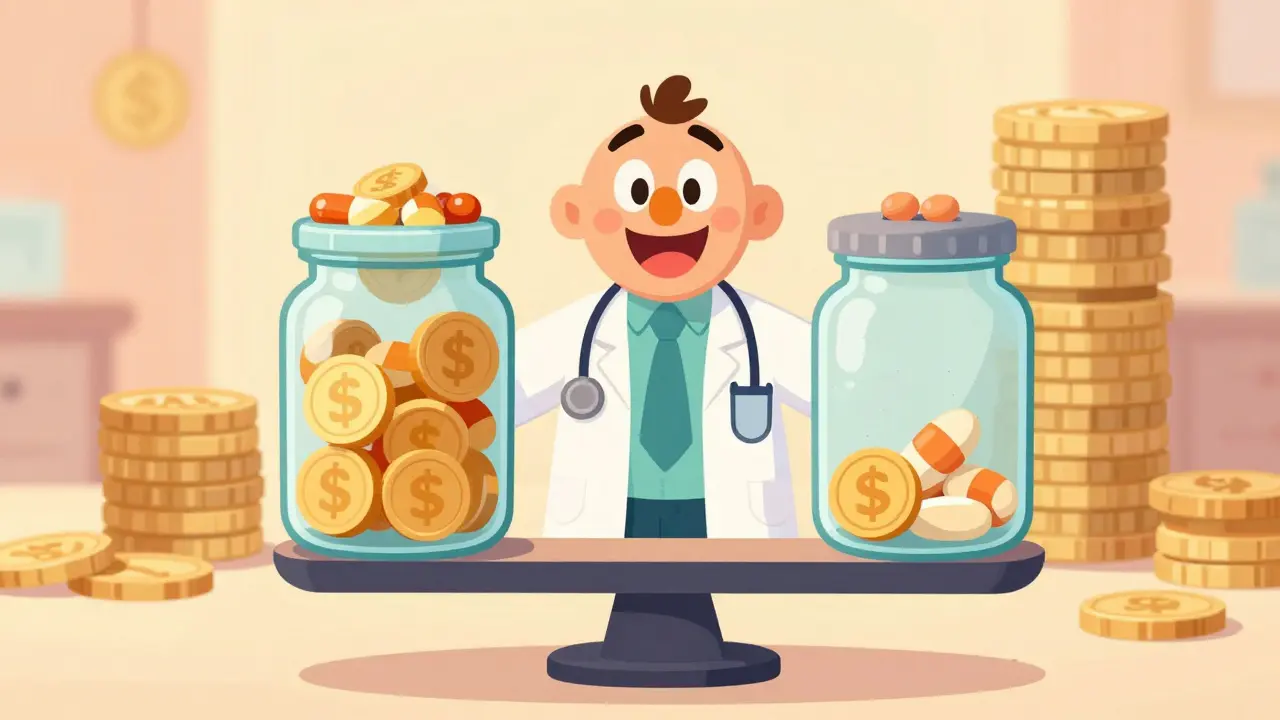
In 2023, generic drugs accounted for 90% of all prescriptions in the U.S., but only 23% of total drug spending. That’s a huge difference in cost-enough to save the healthcare system over $1.7 trillion between 2009 and 2019. But how do doctors and other providers get rewarded for choosing these generics? It’s all thanks to Generic Prescribing Incentives-structured programs where healthcare providers earn rewards for selecting generic medications over brand-name drugs when clinically appropriate. These incentives aim to lower costs without sacrificing treatment quality, and they’ve become a key tool for managing healthcare spending.
What Are Generic Prescribing Incentives?
Generic prescribing incentives are financial or non-financial rewards designed to encourage healthcare providers to choose generic medications when they’re just as effective as brand-name drugs. These programs started gaining traction in the early 2000s as drug costs skyrocketed. By 2006, Medicare Part D formalized them as part of its prescription drug coverage. According to the American College of Physicians (ACP), which published best practice guidelines in 2015, these incentives address the $253 billion annual U.S. spending on prescription drugs. Without them, the healthcare system would spend far more on medications that offer no clinical advantage over cheaper generics.
These incentives come in two main types. Financial rewards include direct payments, performance bonuses, or reduced administrative work. For example, some Blue Cross Blue Shield plans pay providers $5 to $15 per generic prescription for specific drug classes, with annual bonuses reaching $5,000. Non-financial incentives might involve priority appointment scheduling, faster prior authorization processing, or recognition programs. The goal is simple: make prescribing generics easier and more rewarding for providers while keeping costs down for patients and payers.
How These Incentives Work in Practice
Most generic prescribing incentives integrate directly into healthcare systems. For instance, Medicare Part D uses formulary tiering, where generics are placed in the lowest-cost tier. This means patients pay less out-of-pocket, which indirectly encourages providers to choose generics. However, studies show this alone only increases generic utilization by 8-12%-not enough to drive major cost savings.
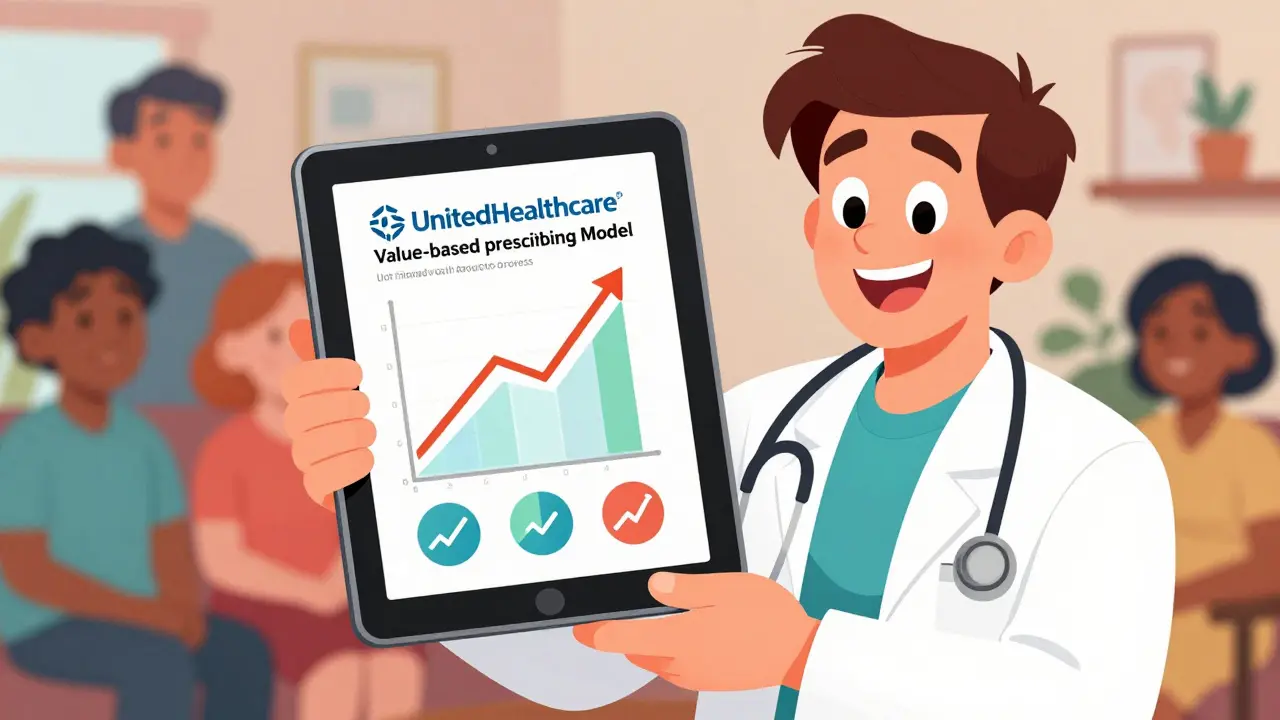
More effective approaches involve direct provider incentives. UnitedHealthcare’s Value-Based Prescribing Program, for example, ties bonuses to generic prescribing rates. In primary care settings, this program increased generic utilization by 24.7% by rewarding doctors with cash incentives for choosing generics. Similarly, Centers for Medicare & Medicaid Services (CMS) tested a "$2 Drug List" in 2021-2022, standardizing copays for essential generics. This led to a 17.3% rise in generic use among Medicare beneficiaries.
Electronic health records (EHRs) also play a big role. Many systems now include "generic-first" default settings, which automatically suggest generics during prescribing. A 2020 study found this feature boosted generic prescribing by 22.4 percentage points compared to systems without defaults. These tools reduce the mental effort needed to choose generics, making it easier for providers to adopt cost-saving practices.
| Model Type | Key Features | Impact on Generic Utilization | Provider Experience |
|---|---|---|---|
| Formulary Tiering | Generics placed in lowest-cost tier; patient co-pays lower | 8-12% increase | Minimal workflow changes; indirect influence |
| Direct Provider Bonuses | $5-$15 per generic prescription; annual caps | 24.7% increase (UnitedHealthcare) | Direct financial reward; low administrative burden |
| Electronic Prescribing Defaults | "Generic-first" settings in EHR systems | 22.4% increase | Automated process; requires EHR integration |
| Reference Pricing (Europe) | Reimbursement based on cheapest therapeutic alternative | 93% generic utilization | System-wide adoption; less provider-specific |
The Impact on Healthcare Costs and Patient Care
These incentives aren’t just about saving money-they also improve patient access to medications. For example, the European reference pricing system, which sets reimbursement levels based on the cheapest available drug in a therapeutic class, achieves 93% generic utilization for off-patent drugs. In the U.S., where generic use averages 85%, this model shows how structured incentives can drive high adoption rates.
But the benefits go beyond cost savings. A 2022 ASPE report found that e-prescribing interventions combined with provider education increased generic utilization by 18.5 percentage points. This not only cut costs but also improved medication adherence, especially for chronic conditions like diabetes and hypertension. When patients stick to their medication regimens, hospitalizations and emergency visits drop, creating a ripple effect of savings across the healthcare system.
However, the impact isn’t always positive. A 2023 JAMA Health Forum study compared 340B-eligible and non-340B clinicians in Medicare Part D. It found that 340B-eligible providers prescribed generics 6.8% less often (52.3% vs. 59.1%). This suggests that certain discount programs can create perverse incentives, where providers might favor more expensive brand-name drugs due to deeper discounts. Similarly, the English National Health Service found that physicians with dispensing rights prescribed 3.1% more expensive drugs per patient, showing how financial alignment can sometimes backfire.
Challenges and Criticisms
Despite their benefits, generic prescribing incentives face significant challenges. One major issue is the potential for conflicts of interest. Research from Duke University in 2016 found that physicians receiving compensation from pharmaceutical companies were 37% less likely to always prescribe generics. This effect was strongest for newer generics within 12 months of market entry. The concern is clear: if providers are financially tied to drug manufacturers, their clinical decisions may be influenced by incentives rather than patient needs.
Another challenge is the "one-size-fits-all" approach. Many programs don’t account for complex cases where brand-name drugs are necessary. On physician forums like Sermo and Reddit, providers often mention this. Dr. Michael Chen (internal medicine, California) reported that UnitedHealthcare’s incentive program added $2,800 to his annual compensation with minimal disruption. But Dr. Sarah Williams (family medicine, Texas) said, "Some incentive programs feel coercive when they restrict clinical judgment for complex cases." A 2021 MGMA survey of 1,200 providers found that 78% expressed concern about potential negative impacts on patient-provider trust if incentives were disclosed to patients.
Implementation issues also arise. A 2022 ASPE survey reported that 68% of organizations faced EHR interoperability problems when trying to integrate incentive programs. Additionally, 52% of implementation failures were due to provider resistance over perceived threats to clinical autonomy. These challenges highlight the need for flexible, nuanced incentive designs that respect clinical judgment.
Current Trends and Future Outlook
Despite these challenges, the trend toward broader adoption continues. The 2022 Inflation Reduction Act includes provisions to strengthen generic competition through patent reform. Experts predict this could increase generic utilization by 5-7 percentage points by 2027. Meanwhile, CMS expanded its "Innovation Center" model in 2023, testing standardized copays for essential generics across Medicare Advantage plans. Preliminary results show a 22.7% improvement in medication adherence for chronic conditions.
UnitedHealthcare is also rolling out "value-based prescribing contracts" in 2024, which tie provider payments to both clinical outcomes and cost efficiency. This shift reflects a growing focus on holistic value rather than just cost reduction. Industry analysts predict generic utilization will reach 94% of prescriptions by 2028, driven by increasingly sophisticated incentive models.
However, risks remain. A 2023 AMA survey found that 61% of physicians cited excessive metric tracking as a source of burnout. There’s also the danger of therapeutic substitution errors-when incentives prioritize cost over clinical appropriateness. For example, a patient with a specific allergy might need a brand-name drug, but an incentive program could push them toward a generic that isn’t suitable. These risks underscore the importance of careful program design.
What Providers Should Know
If you’re a healthcare provider, understanding how these incentives work is crucial. The ACP recommends transparent communication about incentives, aligning them with quality metrics rather than pure cost-cutting, and excluding medications where brand formulation is medically necessary. For example, if a patient has a rare condition requiring a specific brand-name drug, the incentive program should allow exceptions.
Implementation typically requires 8-12 hours of training for providers to fully engage with incentive programs. Practices using EHRs with "generic-first" defaults often see full integration in about 4.2 months. Successful programs also include clinical decision support that only alerts providers to alternatives when appropriate, reducing alert fatigue.
Most importantly, providers should remember that these incentives aren’t meant to replace clinical judgment. They’re tools to help balance cost savings with quality care. As Dr. Steven Dickson and Dr. Kaothip James wrote in a 2023 JAMA Health Forum study, "Financial structures within healthcare delivery systems significantly influence prescribing patterns, and misaligned incentives can undermine cost-saving opportunities even when therapeutic equivalence exists."
What are the main types of incentives for generic prescribing?
There are two main types: financial incentives and non-financial incentives. Financial incentives include direct payments, performance bonuses, or reduced administrative burdens-like Blue Cross Blue Shield paying $5-$15 per generic prescription with annual caps up to $5,000. Non-financial incentives involve priority appointment scheduling, expedited prior authorization processes, or recognition programs. Both types aim to make prescribing generics easier and more rewarding without compromising clinical judgment.
Do these incentives affect patient care quality?
When properly designed, generic prescribing incentives don’t harm quality-they often improve it. For example, the CMS "$2 Drug List" increased medication adherence for chronic conditions by 17.3%, leading to fewer hospitalizations. However, poorly structured programs that don’t account for clinical nuances can risk quality. A 2023 study found that 340B-eligible providers prescribed generics 6.8% less often, suggesting some programs create perverse incentives. The key is balancing cost savings with individual patient needs.
How do electronic health records (EHRs) support generic prescribing?
EHRs play a major role through "generic-first" default settings, which automatically suggest generics during prescribing. A 2020 study showed this feature increased generic prescribing by 22.4 percentage points compared to systems without defaults. EHRs also integrate clinical decision support that alerts providers only when therapeutic alternatives are appropriate, reducing alert fatigue. This makes it easier for providers to choose cost-effective options without disrupting their workflow.
What are the biggest challenges with these incentive programs?
Major challenges include conflicts of interest-like physicians receiving compensation from drug companies leading to 37% lower generic prescribing-and "one-size-fits-all" approaches that don’t account for complex cases. Implementation issues like EHR interoperability problems (reported by 68% of organizations) and provider resistance due to perceived threats to clinical autonomy (52% of failures) also hinder adoption. Additionally, disclosing incentives to patients can erode trust, as 78% of providers in a 2021 survey expressed concern about this.
What’s the future of generic prescribing incentives?
The future looks promising but nuanced. The Inflation Reduction Act’s patent reforms could boost generic utilization by 5-7 percentage points by 2027. UnitedHealthcare’s 2024 value-based contracts will tie payments to both outcomes and costs, shifting focus from pure savings to holistic value. Industry projections suggest generic utilization will reach 94% by 2028. However, careful design will remain critical to avoid burnout from excessive metrics and ensure incentives don’t override clinical judgment for complex cases.