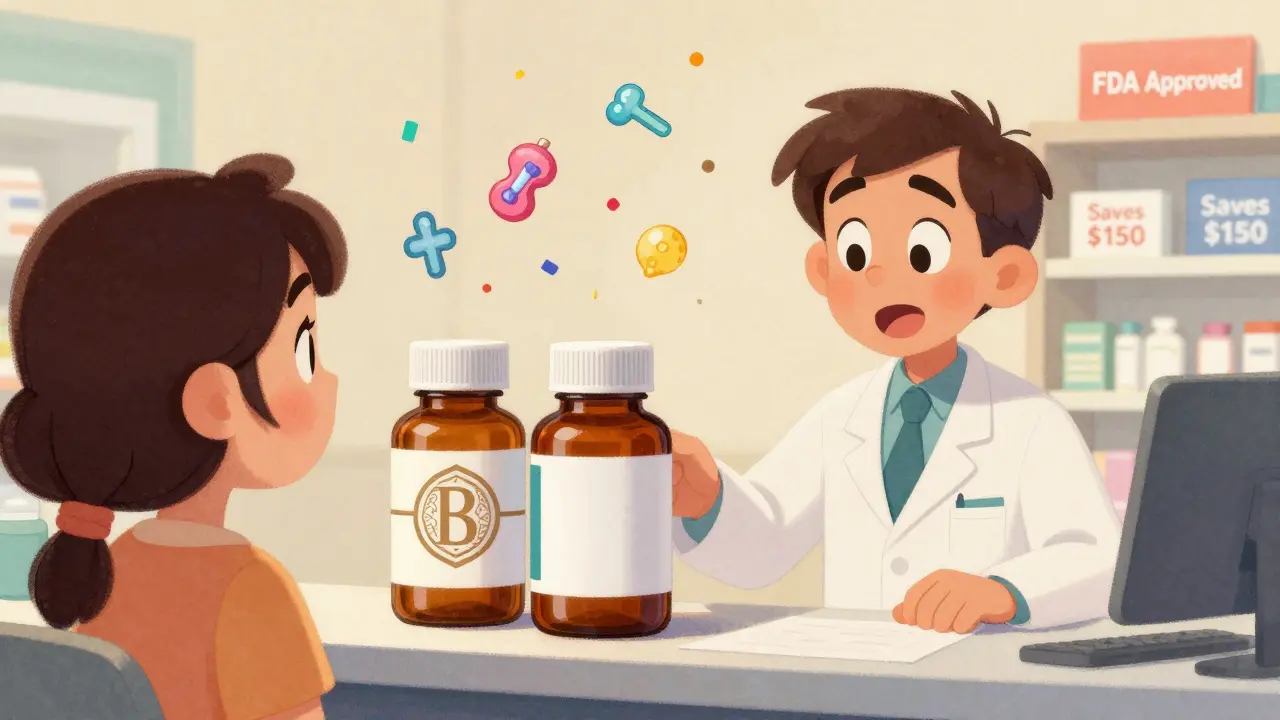
Every time you pick up a prescription, there’s a good chance the pill in your hand isn’t the brand your doctor wrote on the slip. It’s probably a generic. And that’s not an accident - it’s the result of generic substitution laws that vary wildly from state to state. These rules decide whether a pharmacist can swap your brand-name drug for a cheaper generic version - and whether they even have to ask you first.
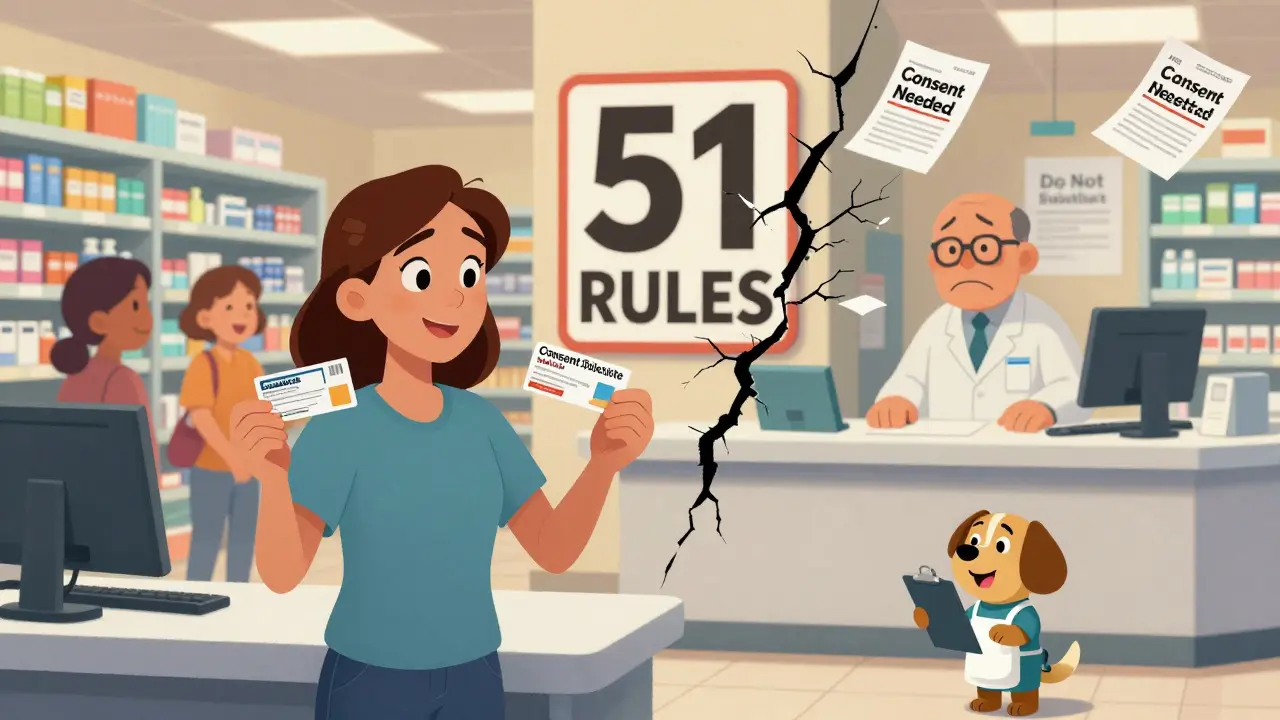
It sounds simple. But in reality, there are 51 different rulebooks across the U.S. and Washington, D.C. One state might require your consent before swapping. Another might let the pharmacist swap automatically. Some ban substitutions for certain drugs entirely. And if you live near a state border? You might get different pills depending on which pharmacy you walk into.
What Exactly Is Generic Substitution?
Generic substitution means replacing a brand-name drug with a chemically identical generic version. The FDA requires generics to have the same active ingredient, strength, dosage form, and route of administration as the brand. They must also meet the same quality and safety standards. The FDA’s Orange Book lists which generics are rated as therapeutically equivalent - meaning they’re considered interchangeable.
But here’s the catch: just because the FDA says two drugs are equivalent doesn’t mean your state lets pharmacists swap them. State laws control what pharmacists can and can’t do behind the counter. These laws were created to cut costs. Generic drugs cost, on average, 80% less than brand-name versions. In 2022, generics made up 90.7% of all prescriptions filled in the U.S. That’s billions in savings.
Still, not all states treat substitution the same way. Some push hard for generics. Others put up roadblocks - often under the guise of patient safety.
States That Require Substitution (Mandatory Laws)
There are 19 states - including California, New York, and Texas - that say pharmacists must substitute a generic when it’s available, unless the prescriber says no. These are called mandatory substitution laws.
In these states, the pharmacist doesn’t need your permission. They don’t even need to tell you ahead of time. They just swap it. The logic? If the drug is FDA-approved as equivalent, why pay more? The FTC found that in mandatory substitution states, generic use is 8-12 percentage points higher than in permissive states. That translates to $50-$150 saved per prescription.
But mandatory doesn’t mean automatic. Prescribers can still write “Dispense as Written” or “Do Not Substitute” on the prescription. And for certain high-risk drugs - like warfarin, levothyroxine, or epilepsy meds - even mandatory states often make exceptions.
States That Allow But Don’t Require Substitution (Permissive Laws)
Thirty-one states and Washington, D.C. use permissive laws. That means pharmacists can substitute, but they don’t have to. The decision is up to them - or sometimes, up to you.
In these places, pharmacists might choose not to swap for a few reasons: they’re unsure about the patient’s history, they’re worried about liability, or they’re just following old habits. Some pharmacies even have policies that default to brand names unless the patient specifically asks for a generic.
And here’s where it gets messy: four of these states - Alaska, Delaware, Maine, and New Hampshire - require pharmacies to post signs saying substitution is possible. But if you don’t see the sign, or you don’t read it, you might never know you could’ve saved money.

When Do You Need to Give Consent?
Seven states - Connecticut, Hawaii, Maine, Maryland, New Hampshire, Vermont, and West Virginia - plus Washington, D.C., require you to give explicit consent before a substitution happens. That means the pharmacist has to ask you, in person or electronically, and you have to say yes.
Hawaii takes it even further. For antiepileptic drugs, they require consent from both you and your doctor. Why? Because these drugs have a narrow therapeutic index - meaning tiny changes in dosage can cause big problems. One study found patients on substituted epilepsy meds had a 30% higher risk of seizures compared to those on the original brand.
These consent rules sound patient-friendly. But they also slow things down. A 2022 study in the American Journal of Managed Care found that in states requiring consent, generic use dropped by 12.7% in the year after a new drug hit the market. Patients didn’t know they had to ask. Pharmacists didn’t push it. And the brand-name drug stayed on the shelf.
What Happens After the Swap?
Even in states that don’t require consent, 31 states and D.C. require pharmacists to notify you after you’ve received a generic. That notice might come on the prescription label, in a printed sheet, or via a text message.
But here’s the problem: most people don’t read the fine print. A 2022 survey by the National Psoriasis Foundation found that 42% of patients on biosimilars (a type of generic biologic) had no idea their medication had been switched. They thought they were still getting the same drug.
Some states go further. In 48 states and D.C., pharmacists must notify the prescribing doctor within 2-7 days after substituting a biologic. That’s meant to help track outcomes - but in practice, many doctors never see the notice. Electronic systems help, but not all pharmacies use them.
Where the Rules Get Weird
Some states have rules that seem out of step with the rest of the country.
Oklahoma requires both the prescriber and the payer (like your insurance) to authorize substitution. That means even if your doctor says yes and the FDA says it’s safe, your insurance company can block it.
Kentucky uses a “positive formulary” - meaning they list which generics are allowed to be substituted. Everything else is off-limits. They specifically ban substitutions for drugs like warfarin, levothyroxine, and certain epilepsy meds. In 2022, they logged over 1,200 incidents where pharmacists accidentally tried to swap these drugs.
Alabama, Arizona, Illinois, Massachusetts, Missouri, Nebraska, New Mexico, Oregon, and Rhode Island don’t protect pharmacists from liability if something goes wrong after a substitution. That means if a patient has a bad reaction, the pharmacist could be sued - even if they followed FDA guidelines. So many of them just don’t swap at all.
Biologics and Biosimilars: A Whole New Layer
Biologics are complex drugs made from living cells - things like Humira, Enbrel, or insulin. Their generics are called biosimilars. They’re not exact copies like small-molecule generics. They’re very similar, but not identical.
The FDA has a special designation for biosimilars: “interchangeable.” Only those can be swapped without a doctor’s approval. But here’s the twist: 45 states have stricter rules for biosimilars than for regular generics. Six states that require generic substitution still treat biosimilars as optional.
And while 90.7% of all prescriptions are for generics, only 11.2% of biologic prescriptions use biosimilars. Why? Because of the laws. Pharmacists are scared. Doctors are cautious. Patients are confused. And insurers often don’t push hard enough to switch.
Why This Mess Exists - And Why It’s Changing
These laws weren’t designed to be this complicated. They started in the 1980s as a way to save money. But over time, each state added its own twist - sometimes to protect patients, sometimes to protect brand-name drug makers, sometimes just because no one bothered to coordinate.
Now, the cost of this patchwork is real. The Congressional Budget Office estimates that if all states standardized their laws, the U.S. could save $4.7 billion a year by 2030 just by reducing unnecessary brand-name use.
There are signs of change. In 2023, 12 states introduced bills to harmonize substitution rules. The FDA updated its Orange Book to include new “interchangeability” ratings for complex generics. And electronic health record systems like Epic now automatically apply the right state rules based on the pharmacy’s location - cutting errors by 37%.
Still, the biggest barrier isn’t technology. It’s awareness. Most patients don’t know they have a right to a cheaper drug. Most pharmacists juggle 51 different rule sets. And too often, the system favors inertia over savings.
What You Can Do
You don’t need to be a policy expert to save money on your meds. Here’s what actually works:
- Ask your pharmacist: “Is there a generic version of this drug?” Even in permissive states, they can tell you if one exists.
- Check your prescription label. If it says “Dispense as Written,” you can ask your doctor to remove that note.
- If you’re on a high-risk drug (like warfarin or seizure meds), ask whether substitution is allowed - and whether your state requires consent.
- Use the FDA’s Orange Book app. It’s free. It tells you if a generic is rated equivalent.
- When you move or travel, ask your new pharmacy about their substitution policy. Don’t assume it’s the same as where you came from.
Generic drugs aren’t inferior. They’re the same medicine, just cheaper. But you won’t get the savings unless you know the rules - and you ask for them.