
Missing a pill happens to almost everyone. Maybe you overslept. Maybe you were in a rush. Maybe you just forgot amid the chaos of daily life. But what you do next matters more than you think. Taking a double dose to make up for a missed one isn’t just a bad idea-it can be dangerous. In England alone, around 14.2% of preventable hospital admissions linked to medication errors come from people doubling up after forgetting a dose. That’s not a small risk. It’s a real, avoidable threat to your health.
Why Doubling Up Is Never the Answer
The urge is understandable. You missed your 8 a.m. blood pressure pill, and by noon you’re thinking, “I should just take two now.” But that logic ignores how your body processes medicine. Drugs aren’t like coffee-you can’t just pour in an extra shot to catch up. Many medications, especially those with a narrow therapeutic index, work within a very tight range. Too little, and they don’t work. Too much, and they become toxic. Warfarin, digoxin, and antiepileptic drugs fall into this category. A 2018 study found that 17.3% of adverse drug events in older adults were caused by improper handling of missed doses. For warfarin users, doubling a dose can send INR levels above 5.0, which dramatically increases the risk of internal bleeding. For methotrexate, even one extra milligram can cause severe bone marrow suppression. The NHS Specialist Pharmacy Service, the FDA, and Australia’s Therapeutic Goods Administration all agree: never take a double dose. It’s not a suggestion. It’s a safety rule backed by years of clinical data and real-world harm.What to Do Instead: The Timing Rule
The right action depends on one thing: how much time is left until your next scheduled dose. For most medications, there’s a simple guideline: if you remember you missed a dose before the halfway point to your next one, take it. If you’re past that point, skip it. This is called the midpoint rule. Let’s say you take a pill every 12 hours-at 8 a.m. and 8 p.m. If you realize at 11 a.m. that you missed your morning dose, you’re only three hours into the 12-hour window. Halfway would be 2 p.m. So you take the missed dose now, and then take your next one at 8 p.m. as usual. But if you don’t remember until 3 p.m., you’re past the halfway mark. Taking the missed dose now would mean you’re only five hours away from your next scheduled dose. That’s too close. In this case, skip the missed dose. Take your next one at 8 p.m. Don’t double. Don’t try to “make up” for it. Just reset.One-Dose-a-Day Medications
If you take a pill once a day-like a statin, a thyroid hormone, or a blood pressure pill-you have a little more flexibility. The NHS recommends taking the missed dose as soon as you remember, but only if it’s still the same calendar day. If you forget your morning pill and remember at 8 p.m., go ahead and take it. Then take your next dose at the usual time tomorrow. But if you don’t remember until the next morning? Skip it. Don’t take two pills on day two. Your body doesn’t need a double load. It just needs consistency. One missed dose won’t undo weeks of treatment. But doubling up might land you in the hospital.Twice-Daily and Special Cases
For twice-daily meds, the 6-hour window is your safety buffer. If your schedule is 7 a.m. and 7 p.m., you can take a missed dose up to 1 p.m. or 1 a.m. without risking overlap. After that, skip it. Some medications have unique rules. Oral contraceptives are one. If you miss an active pill by less than 12 hours, take it as soon as you remember. If it’s more than 12 hours late, take it but use backup contraception for the next seven days. The protection drops after that window. GLP-1 weight loss drugs like semaglutide or tirzepatide are another exception. You can take a missed dose up to four days late, but never double. If you miss two doses in a row (14 days without the drug), you might feel nauseous when you restart. That’s normal-but it’s not a reason to push through with a double dose. Talk to your doctor instead.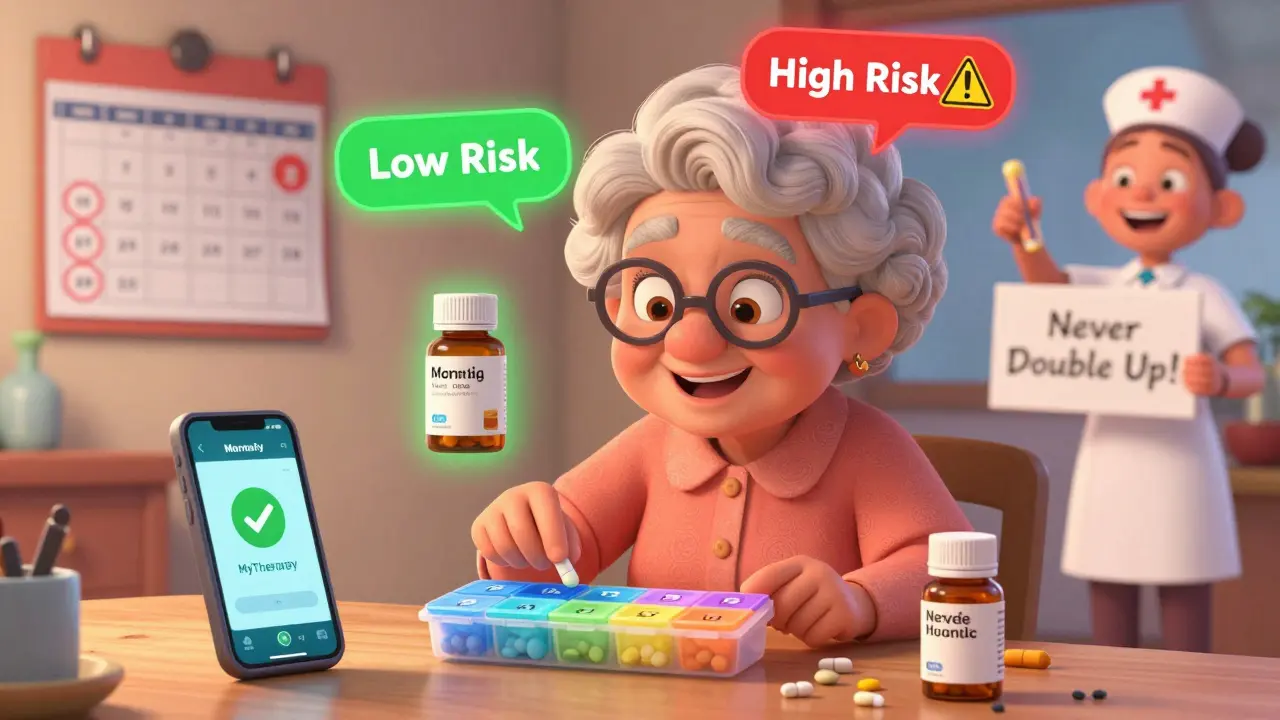
High-Risk Medications: Know Your Category
Not all medications are created equal. The National Patient Safety Agency classifies them into three risk levels:- Red (highest risk): Anticoagulants, antiepileptics, insulin, methotrexate. Missing a dose can cause immediate harm. These require strict timing. Skip if you’re close to the next dose.
- Amber (moderate risk): Blood pressure pills, some antidepressants. Missing one dose might cause a temporary spike or dip, but it’s not immediately dangerous. Use the midpoint rule.
- Green (low risk): Most statins, vitamin D, some supplements. One missed dose won’t make much difference. Just take it when you remember, even if it’s later in the day.
Why You Can’t Trust Your Memory-or Your Pharmacist
Here’s the scary part: even professionals can give conflicting advice. A patient in Leeds reported getting three different answers about her blood pressure pills from three different pharmacists. That’s not rare. A 2022 survey found that 41.7% of patient leaflets contain contradictory or unclear guidance. This isn’t your fault. The system is messy. But you can protect yourself. Write down the missed-dose rule for each of your meds. Keep it on your phone or in your wallet. Use apps like MyTherapy or Medisafe-they send reminders and tell you exactly what to do if you miss a pill. Users of these apps report a 42.3% drop in missed doses.What to Do If You Already Took a Double Dose
If you’ve already taken two pills by mistake, don’t panic-but don’t ignore it either. Call your pharmacist or NHS 111. Tell them:- What medication you took
- How much you took
- When you took it
- Any symptoms you’re feeling (dizziness, nausea, irregular heartbeat, bleeding)
Prevention Is Better Than Correction
The best way to handle a missed dose? Avoid it in the first place.- Use a pill organizer with days and times labeled.
- Set two alarms: one for when to take it, one as a backup.
- Link your pill to a daily habit: brush your teeth, eat breakfast, turn off the lights.
- Ask your pharmacist for a blister pack if you take multiple pills.
- Use a digital tracker. Even a simple calendar reminder on your phone works.
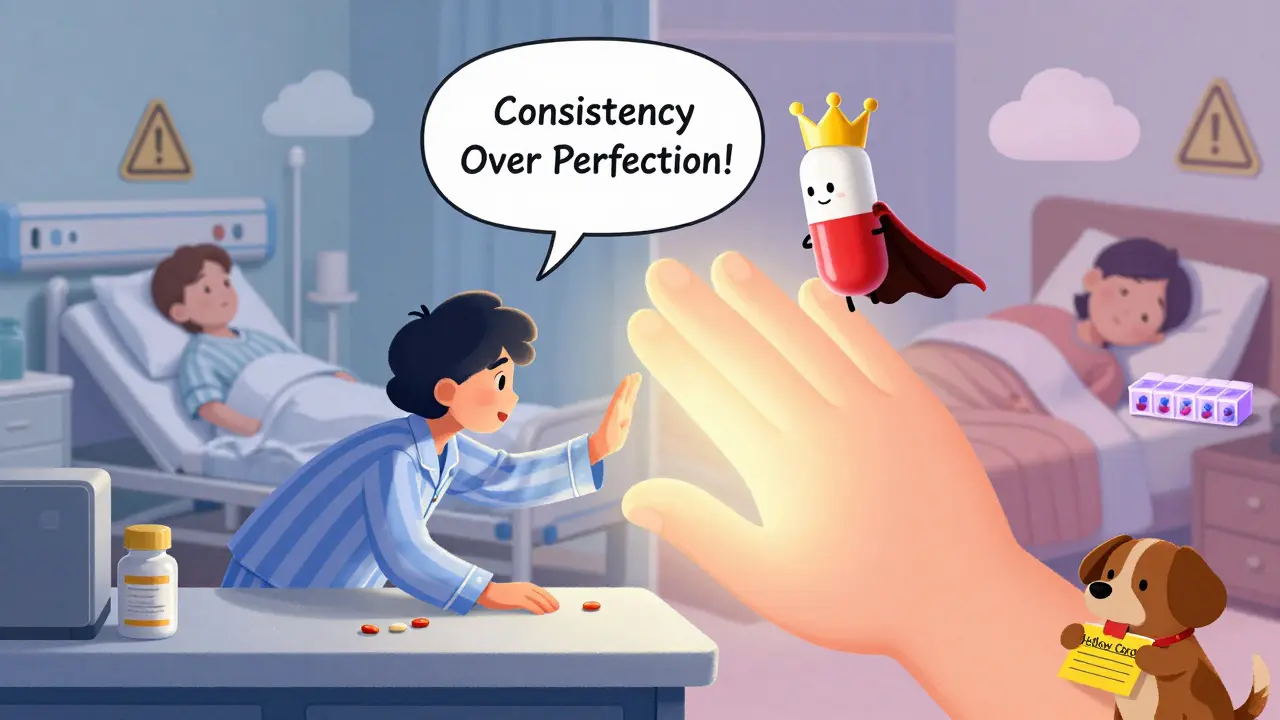
Final Thought: Consistency Over Perfection
Medication adherence isn’t about being perfect. It’s about being smart. One missed dose won’t ruin your treatment. But doubling up could. Your body doesn’t need extra medicine-it needs steady, predictable levels. If you’re unsure what to do, always check with your pharmacist. Don’t rely on memory, internet searches, or guesswork. Your health is too important for that.Take your meds on time when you can. Skip when you must. Never double. That’s the simple, life-saving rule.
What should I do if I miss a dose of my blood pressure medication?
If you miss a dose of your blood pressure pill, take it as soon as you remember-but only if it’s still the same day and you’re not too close to your next dose. For once-daily meds, take it if you remember before bedtime. For twice-daily meds, use the 6-hour window rule: if it’s been less than 6 hours since your scheduled time, take it. If it’s more, skip it. Never double up. Missing one dose won’t cause harm, but doubling could raise your risk of dizziness, low blood pressure, or even a stroke.
Is it safe to double a dose of antibiotics like amoxicillin?
In most cases, no. But there’s one exception: some short-course antibiotics like amoxicillin may allow doubling the first missed dose if it’s been less than 2-3 hours since your scheduled time. This is rare and only applies to a small group of medications. Even then, it’s not a general rule. Always check your leaflet or call your pharmacist. For 97% of other medications-including most antibiotics like doxycycline or ciprofloxacin-doubling is unsafe and unnecessary.
What happens if I miss a dose of warfarin?
If you miss your warfarin dose and remember before midnight, take it then. If you don’t remember until the next morning, skip it. Never take two pills to make up for it. Warfarin has a narrow therapeutic range-too much can cause dangerous bleeding. The NHS Warfarin Record (Yellow Book) clearly states this rule. If you miss two doses in a row, contact your anticoagulation clinic. Your INR level may need checking.
Can I take a missed pill the next day if I forgot yesterday?
No. Never take a missed pill from the previous day. That’s the same as doubling up. For example, if you forget your daily thyroid pill on Monday, don’t take two on Tuesday. Just resume your normal schedule on Tuesday with one pill. Your body adjusts quickly to small gaps. Taking two pills can cause side effects like rapid heartbeat, anxiety, or insomnia, especially with levothyroxine.
Why do some pill leaflets say to take missed doses immediately, while others say to skip?
Because the instructions aren’t standardized. A 2021 review found that 25% of high-risk medications have no clear guidance in their leaflets, and 41.7% of all leaflets contain confusing or conflicting advice. Some older leaflets still say “take as soon as remembered” without context. That’s outdated. Always follow the midpoint rule or ask your pharmacist. Don’t trust the leaflet if it doesn’t mention timing or risk category.
How do I know if my medication has a narrow therapeutic index?
Ask your pharmacist or check your prescription label. Medications with a narrow therapeutic index include warfarin, digoxin, lithium, phenytoin, theophylline, and methotrexate. These require very precise dosing. If your medication is used to treat seizures, heart conditions, or blood clotting, it’s likely high-risk. If you’re unsure, look up the drug name on the NHS Medicines A-Z website or call the NHS helpline. Better safe than sorry.
Should I use a pill reminder app?
Yes, especially if you take multiple medications or have trouble remembering. Apps like MyTherapy or Medisafe send alerts, track missed doses, and tell you exactly what to do if you forget. A 2023 study showed users reduced missed doses by 42.3%. These apps are free, easy to use, and work offline. They’re especially helpful for older adults and people managing chronic conditions like diabetes or heart disease.