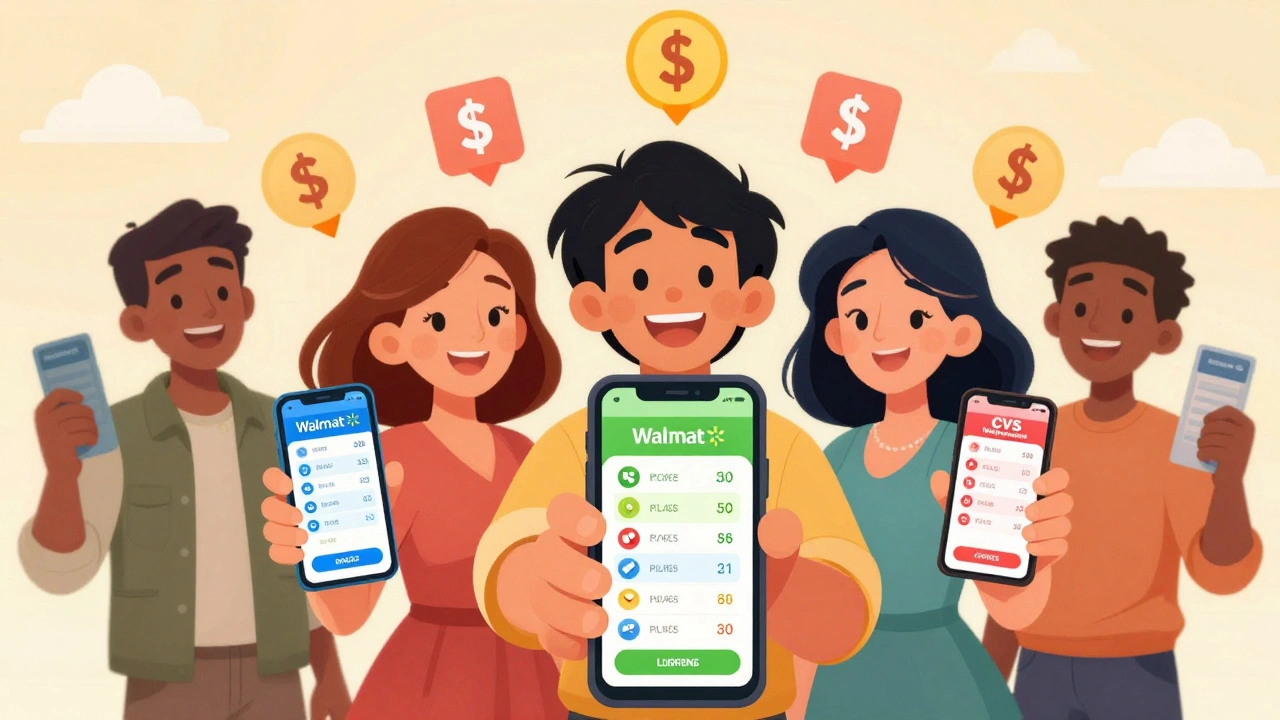
Every year, millions of Americans pay hundreds or even thousands of dollars out of pocket for prescriptions they don’t fully understand the cost of. You walk into a pharmacy, hand over your insurance card, and wait while the pharmacist runs your script. Then you’re told it’s $320 for a 30-day supply of your medication. You nod, pay, and leave - but what if you could’ve paid $85 instead? That’s not a hypothetical. It happens every day. And the reason? Most people don’t know where to look for better prices.
That’s where price transparency tools come in. These are free, online platforms built into your insurance portal or available as standalone apps that show you exactly how much a drug will cost at different pharmacies near you - before you even fill the prescription. No more guessing. No more surprise bills. Just real numbers, real savings.
Why Drug Prices Vary So Wildly
It’s not magic. It’s not even chaos. It’s a broken system. The same 10mg tablet of metformin can cost $4 at Walmart and $120 at a specialty pharmacy down the street. Why? Because pharmacies negotiate different prices with your insurance plan. Some have contracts that give them lower wholesale rates. Others don’t. And unless you’re checking, you’re stuck paying the highest price.
Here’s the kicker: your insurance doesn’t always pay the list price. They negotiate a lower rate - but that doesn’t mean you’re getting the benefit. Your copay is often based on the drug’s list price, not the negotiated one. So even if your insurer paid $20 for the pill, you might still pay $60 because that’s what the pharmacy charges everyone without insurance.
Price transparency tools fix this by showing you your actual out-of-pocket cost - not the sticker price. They pull data from your plan’s negotiated rates and combine it with pharmacy pricing. That means you see what you’ll really pay, not what the pharmacy advertises.
What Tools Actually Work?
Not all tools are created equal. Some are clunky. Some only show list prices. Others give you real savings. Here are the ones people actually use to cut their drug bills:
- Rx Savings Solutions (RxSS): This tool is built into many employer health plans and pharmacy benefit manager portals. It doesn’t just show prices - it suggests cheaper alternatives. If you’re on a $200 brand-name drug, it might recommend a generic version that works just as well for $15. In one 2023 study, 83% of users found cost-saving options through RxSS.
- Optum Rx: If your insurance is through a large employer (like Amazon, Target, or Walmart), you likely have access to Optum Rx through your myCompass account. It shows real-time pricing across 65,000+ pharmacies and integrates directly with your plan. Users report saving $100-$500 per prescription.
- FAIR Health Consumer: This one’s great if you don’t have insurance or your plan doesn’t offer a tool. It’s free, doesn’t require login, and gives you price ranges for any drug in any zip code. It’s like Google Maps for drug prices.
- Turquoise Health: Used by hospitals and PBMs, but also available to consumers. It shows pricing data from over 1,200 payers and 4,000+ drugs. Best for complex prescriptions or specialty meds.
- Healthcare Bluebook: More focused on procedures, but it includes some common drugs. If you’re managing chronic conditions like diabetes or high blood pressure, it’s worth checking.
According to the Commonwealth Fund’s 2023 review, Rx Savings Solutions got the highest rating (4.6/5) for pharmacy cost savings. Optum Rx came in second (4.3/5). FAIR Health is the only one you can use without insurance.
How to Use These Tools - Step by Step
Using a price transparency tool isn’t complicated. But if you skip steps, you’ll miss savings. Here’s how to do it right:
- Check if your plan has a built-in tool. About 78% of large employers now offer one. Log into your insurance portal or call your benefits team. Ask: “Do you offer a prescription price comparison tool?” If yes, find it. It’s often under “Pharmacy” or “Cost Estimator.”
- Enter the exact drug name, dose, and quantity. Don’t say “my blood pressure pill.” Type in “lisinopril 10mg tablet, 30 count.” Precision matters. Tools don’t guess.
- Compare prices across at least 3 pharmacies. Look within a 5-10 mile radius. Sometimes the closest one is the most expensive. CVS, Walgreens, and Walmart often have wildly different prices for the same drug.
- Check for therapeutic alternatives. If your tool suggests a generic or similar drug (like switching from Brand X to Generic Y), read the description. Most alternatives are clinically equivalent. You’re not sacrificing quality - you’re saving money.
- Verify before you pick up. Even the best tools can be off by a few dollars due to insurance processing delays. Call the pharmacy and say: “I’m using my insurance. What’s my out-of-pocket for [drug name]?” Confirm the price they give you matches the tool.
Most people take 15-20 minutes for their first search. After three times, it takes under 7 minutes. That’s less time than waiting in line.
Real Savings, Real Stories
People aren’t just saving a few bucks. They’re saving hundreds - sometimes thousands - per year.
One user on Reddit, ‘MedSaver2023,’ used Rx Savings Solutions to compare apixaban (a blood thinner). The tool showed a local pharmacy charging $310 for a 90-day supply. Another pharmacy, 3 miles away, charged $23. He saved $287 - on a single prescription.
Another user, ‘BudgetPharma,’ used Optum Rx to track their annual meds. They went from paying $1,850 per year to $620 - a 66% drop. How? They switched from brand-name drugs to generics and found pharmacies with better negotiated rates.
A Kaiser Health News report in 2023 told the story of a patient who was billed $4,200 for an MRI. They used Healthcare Bluebook, found a facility 12 miles away charging $450, and switched. That’s not luck. That’s using the tool correctly.
What These Tools Can’t Do (And What to Watch Out For)
Price transparency tools aren’t perfect. Here’s what you need to know:
- They don’t always include discount programs. Tools like GoodRx, SingleCare, or RxSaver offer cash prices that sometimes beat insurance. Don’t assume the tool shows the lowest possible price. Always check GoodRx too.
- Some tools show list prices, not your cost. If you see a $1,000 price and your tool says you pay $300, that’s good. But if the tool shows $1,000 as your cost - that’s wrong. Look for labels like “your estimated cost” or “out-of-pocket.” If it says “retail price,” ignore it.
- Specialty drugs are tricky. If your drug needs prior authorization or is only available through a specialty pharmacy, tools may not show accurate pricing. You’ll still need to call your insurer.
- Insurance changes can break estimates. If your plan updates its formulary or you switch jobs, your tool’s data might be outdated. Re-check every 3-6 months.
According to G2’s 2024 review of Trustpilot data, 38% of users got confused between list prices and actual costs. That’s why step five - calling the pharmacy - is non-negotiable.
The Bigger Picture: Why This Matters
This isn’t just about saving a few bucks on your next script. It’s about fixing a broken system. In 2023, Americans spent over $370 billion on prescription drugs. The Congressional Budget Office estimates that if everyone used price transparency tools, we could save $18.7 billion annually.
States like California and Florida now require drug makers to report price hikes. The federal government mandates that insurers provide these tools. But none of it matters if you don’t use them.
Every time you compare prices, you’re pushing the system to be fairer. Pharmacies start lowering prices when they know you can see them. Insurers negotiate harder when they know you’re shopping around. Your action creates change.
What’s Next?
The tools are getting smarter. AI is being used to predict future price drops. Blockchain is being tested to verify pricing data. By 2026, experts predict 90% of prescriptions will be checked with a price tool first.
Start today. Open your insurance app. Search for your next prescription. Compare three pharmacies. Try a generic. Call one to confirm. That’s it. No apps to download. No sign-ups. Just five minutes and a few clicks.
You’re not just saving money. You’re taking control.
Are price transparency tools free to use?
Yes. All major tools - including Optum Rx, FAIR Health, Rx Savings Solutions, and Healthcare Bluebook - are free for consumers. You don’t need to pay for access. Some are built into your insurance portal, while others like FAIR Health work without login.
Can I use these tools if I don’t have insurance?
Absolutely. FAIR Health Consumer is designed for uninsured patients. It shows cash prices across pharmacies in your area. You can also use GoodRx or SingleCare, which often offer lower cash prices than insurance copays. Always compare both.
Why does the price change when I pick up my prescription?
Insurance systems sometimes take hours or days to update your eligibility or formulary status. Your tool gives an estimate based on the latest data, but if your plan’s system hasn’t synced, the pharmacy might bill differently. Always confirm the final price at the counter before paying.
Do these tools work for specialty medications?
They can, but with limits. Specialty drugs often require prior authorization or are only available through certain pharmacies. Tools may show a price, but if your insurer hasn’t approved the drug, you’ll still pay full price. Always call your insurer to confirm coverage before switching.
How often should I check drug prices?
Check every time you refill - especially if you’re on long-term medication. Drug prices change often, and your insurance plan might update its formulary. Even if you saved $200 last time, you could save $300 this time. Make it part of your refill routine.
Can I use these tools for my family members?
Yes, if they’re on the same insurance plan. Most tools let you switch between family members in your account. If they have different insurance, you’ll need to log in separately or use FAIR Health, which doesn’t require insurance details.
What if the tool doesn’t show my drug?
Try searching with the generic name instead of the brand name. If it’s still not listed, it may be a new or very rare drug. In that case, call your pharmacy and ask for the cash price. Then check GoodRx. Most drugs have at least one alternative or discount option.
Comments
Ariel Nichole
This is such a game-changer. I had no idea my insulin was costing me $400 when I could’ve paid $35 at Walmart. I just checked my insurance portal and found a pharmacy 2 miles away that cuts my bill in half. Why isn’t this common knowledge?
Thank you for laying this out so clearly.
On December 10, 2025 AT 11:11
john damon
OMG I JUST SAVED $287 ON MY BLOOD THINNER 😱 I used RxSS and it literally showed me a pharmacy 3 blocks away charging $23 instead of $310. I felt like a financial wizard. 🤓💸
On December 10, 2025 AT 16:11
matthew dendle
lol people act like this is some big secret but its just basic shopping dumbass. you dont buy a tv from the first store you see right? why would you buy pills like that? and yeah goodrx is still better than most of these tools. also why are we still paying for meds at all in this country??
On December 10, 2025 AT 16:59
Monica Evan
I used to be terrified of refilling my antidepressants because I never knew what I’d get hit with. Then I found FAIR Health. It’s not perfect, but it’s the first time I felt like I had any power in this system. I’ve saved over $1,200 this year. It’s not just money - it’s peace of mind.
Also, always check the generic. I switched from Lexapro to escitalopram and didn’t notice a difference. Just saved $90/month. You’re not weak for choosing cheaper - you’re smart.
On December 12, 2025 AT 05:19
Taylor Dressler
This guide is excellent. One thing to emphasize: always verify with the pharmacy before picking up. Tools can be off by $5–$20 due to real-time insurance sync delays. I’ve had cases where the tool said $12, but the pharmacy charged $38 because my deductible hadn’t updated. A quick 30-second call saves headaches. Also, don’t overlook mail-order options - sometimes they’re cheaper than local pharmacies, especially for 90-day supplies.
On December 12, 2025 AT 18:03
Aidan Stacey
I used to cry in the pharmacy aisle because I couldn’t afford my meds. Then I found out my employer’s portal had a tool that showed me a $15 alternative to my $220 brand. I didn’t even know generics could be that good. Now I tell everyone I know. This isn’t just a tip - it’s a lifeline. People are dying because they skip doses. We need to normalize this like checking prices before buying a car.
On December 13, 2025 AT 08:29
Jim Irish
Price transparency is a basic consumer right. The fact that we need tools to do this at all speaks to systemic failure. That said, the tools mentioned are effective. Use them. Check every refill. Your health depends on it.
On December 14, 2025 AT 20:25
Mia Kingsley
Y’all are acting like this is new news. I’ve been using GoodRx since 2018. Also, most of these tools are owned by the same PBMs that charge the high prices. They want you to think you’re saving money so you don’t get mad at them. The real solution? Single-payer. Or at least cap prices. This is just a bandaid on a bleeding artery.
On December 16, 2025 AT 19:40
Katherine Liu-Bevan
I work in pharmacy billing. I see this daily. Patients pay full price because they don’t know better. The tools listed are accurate if used correctly. The biggest mistake? Assuming the first price shown is the lowest. Always compare at least three locations. Also, some pharmacies offer loyalty discounts not reflected in apps - ask the pharmacist. They’re often willing to help if you’re polite.
On December 18, 2025 AT 00:39
Courtney Blake
So now we’re supposed to be grateful for tools that help us survive a broken system? We’re in a country where people choose between insulin and rent. This isn’t empowerment - it’s damage control. And don’t get me started on how these tools are built by the same corporations that profit from the high prices. This is performative transparency. Real reform would cap prices. Not make us play pharmacy roulette.
On December 19, 2025 AT 22:15
Lisa Stringfellow
This is just more guilt-tripping. Like, oh, if you just spent 20 minutes comparing prices you wouldn’t be poor. What about people who work two jobs and can’t afford to spend time on this? Or those without smartphones? Or people who are sick and exhausted? This feels like blaming the victim.
On December 20, 2025 AT 10:23
Kristi Pope
I used to think I was just bad at money. Turns out I was just using the wrong pharmacy. I switched from CVS to a local independent one using RxSS - saved $150 on my thyroid med alone. Now I do it every refill. It’s become a ritual. Like checking the weather before leaving the house. And yeah, I still use GoodRx on the side. Why not? Free money is free money.
Also, shoutout to the pharmacist who told me about this. She didn’t have to. She just did.
On December 21, 2025 AT 19:00
Aman deep
I’m from India, but my sister lives in Texas and she showed me this. We were both shocked. In India, drug prices are regulated, and generics are the norm. Here, you need a detective app just to not get robbed. This post is a gift. I shared it with my family back home - they couldn’t believe it. This isn’t just American. It’s a global shame.
On December 21, 2025 AT 20:48
Eddie Bennett
I tried this last month for my dad’s blood pressure med. Tool said $22. Pharmacy said $48. I called the insurance. Turned out he was on the wrong tier. They fixed it. Saved $260. I didn’t even know that was a thing. I’m not techy at all. If I can do it, anyone can. Just take 10 minutes. Your future self will thank you.
On December 22, 2025 AT 09:02
Sylvia Frenzel
I’m not buying this. If these tools were so effective, why do pharmacies still charge $1,000 for a single dose of some drugs? This is corporate theater. They want you to think you’re in control so you don’t demand real change. Also, I tried FAIR Health. It gave me a price for a drug that doesn’t even exist. So much for accuracy.
On December 23, 2025 AT 21:29
Paul Dixon
I used to be too lazy to check. Then my kid needed a $300 antibiotic and I just… didn’t pay it. That’s when I found out about GoodRx. Got it for $18. I’ve been using tools ever since. Now I check before I even ask my doctor for a script. It’s weirdly empowering. Like I’m not just a patient - I’m a shopper.
On December 25, 2025 AT 12:10
Vivian Amadi
You missed the most important tool: calling your doctor and asking for samples. Or switching to a different drug entirely. Why are you all just optimizing within a broken system? The real answer is: stop prescribing expensive crap in the first place. But no, let’s just make people play a game of price bingo.
On December 26, 2025 AT 05:01
Jimmy Kärnfeldt
There’s something deeply human about this. We’re not just talking about money - we’re talking about dignity. Being able to afford your medicine without shame. I used to hide my prescriptions because I couldn’t pay. Now I walk into the pharmacy like I own the place. I know the price. I know my options. I’m not begging. I’m choosing. That’s power. And it’s free.
On December 27, 2025 AT 23:42