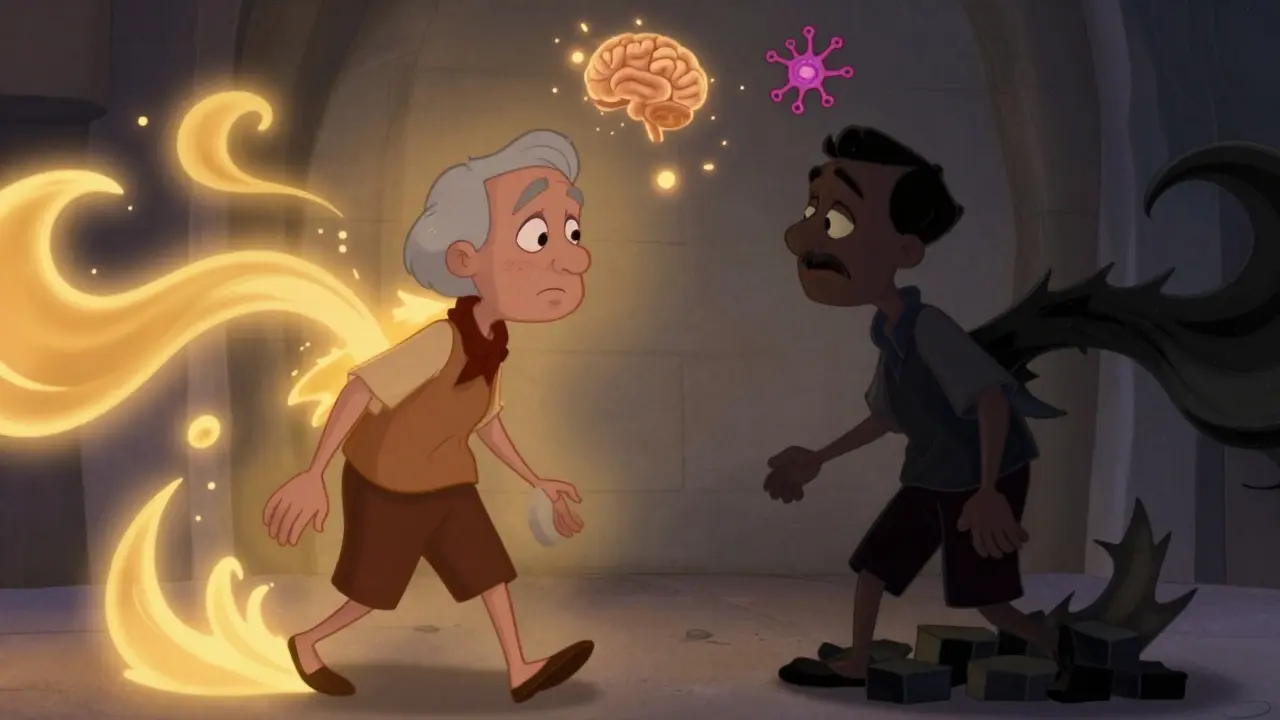
When someone with Parkinson’s disease starts showing hallucinations or delusions, doctors face a nightmare scenario: treat the psychosis and risk making the tremors worse, or leave the psychosis untreated and watch quality of life collapse. The reason? Levodopa and antipsychotics don’t just work differently - they fight each other inside the brain.
How Levodopa Works - and Why It’s a Double-Edged Sword
Levodopa is the gold standard for treating Parkinson’s. It’s not dopamine itself, but a chemical your brain turns into dopamine. That’s the whole point: Parkinson’s destroys the neurons that make dopamine, so levodopa steps in to replace what’s lost. But here’s the catch - as the disease progresses, your brain loses its ability to regulate dopamine. Healthy neurons store and release dopamine slowly, like a steady drip. In advanced Parkinson’s, those neurons are gone. What’s left are patchy, overworked cells that dump dopamine all at once when levodopa arrives.
This creates wild swings in dopamine levels. One study using PET scans showed that the same dose of levodopa produces dramatically higher dopamine spikes in someone with advanced Parkinson’s compared to someone in the early stages. These spikes don’t just help movement - they flood areas of the brain linked to thinking and perception. That’s why 15-20% of people on levodopa develop psychotic symptoms, even if they never had them before.
How Antipsychotics Fight Psychosis - and Make Parkinson’s Worse
Antipsychotics like haloperidol, risperidone, or even quetiapine work by blocking dopamine receptors - especially the D2 kind. That’s how they calm down hallucinations and paranoia in schizophrenia: they reduce dopamine signaling where it’s too high. But in Parkinson’s, dopamine is already too low in the motor parts of the brain. Block those receptors, and movement gets even harder.
It’s not a subtle effect. Studies show that when antipsychotics are added to Parkinson’s treatment, motor symptoms worsen by 25-35% on standard rating scales. A 2015 study of 127 Parkinson’s patients found that even low doses of risperidone caused a sharp spike in rigidity, slowness, and balance problems within days. One patient described it like this: “I could walk to the kitchen before. After the pill, I needed a walker. It felt like my legs turned to concrete.”
And it gets worse. Some antipsychotics - especially older ones like haloperidol - don’t just block dopamine receptors. They trigger a dangerous chain reaction. By blocking the brain’s own “brakes” on dopamine release (called autoreceptors), they cause dopamine to spill out uncontrollably. When you stop the drug, the brain is left with more receptors than ever, making it hypersensitive. This is why sudden withdrawal of antipsychotics can trigger neuroleptic malignant syndrome (NMS), a life-threatening condition with fever, muscle rigidity, and confusion. The risk is small - about 1 in 5,000 Parkinson’s patients - but the outcome can be fatal.
The Perfect Storm: When Parkinson’s and Psychosis Collide
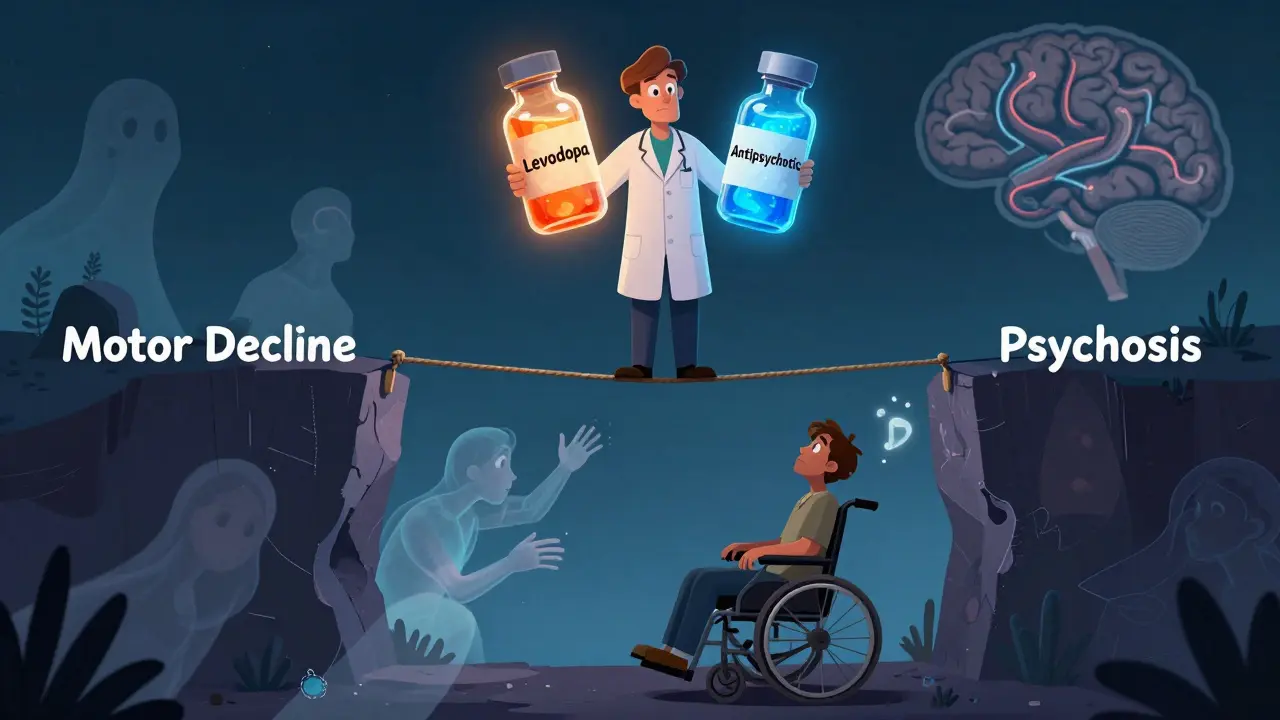
Thirty to forty percent of people with Parkinson’s develop psychosis over time. It’s not rare - it’s expected. But treating it is like walking a tightrope. You can’t stop levodopa - without it, they can’t move. You can’t use most antipsychotics - they’ll lock them in place.
Doctors have tried to solve this with a few options. Quetiapine is often the first choice because it’s “dopamine-sparing” - it doesn’t block D2 receptors as strongly. But even then, 30-50% of patients still get worse motor symptoms. Pimavanserin, approved in 2016, is the only antipsychotic designed specifically for Parkinson’s psychosis. It doesn’t touch dopamine at all. Instead, it blocks serotonin receptors (5-HT2A). That’s why it doesn’t worsen movement - and why it costs over $30,000 a year. Still, only 42% of movement disorder specialists have prescribed it, mostly because of cost and access.
What about the reverse? Giving levodopa to someone with schizophrenia? It’s dangerous. A 1988 study gave levodopa to schizophrenia patients on stable antipsychotics. Sixty percent had their hallucinations and delusions return - even at low doses of 300 mg. One patient, who’d been symptom-free for two years, said: “The voices came back louder than ever. I thought I was losing my mind again.”
Real Stories from the Clinic
At the Cleveland Clinic, 17 Parkinson’s patients developed severe motor decline within 72 hours of starting risperidone at just 0.5 mg per day. One man, 74, went from walking unassisted to needing a wheelchair. His UPDRS score - a standard measure of Parkinson’s severity - jumped 42 points. At Zucker Hillside Hospital, nine schizophrenia patients were given levodopa for suspected Parkinsonism. All had psychotic relapses within 48 hours. Their PANSS scores - used to measure psychosis - rose from 70 to over 100.
Online forums tell the same story. On Reddit’s r/Parkinsons, over 200 posts describe worsening mobility after antipsychotics. One user, ParkinsonsWarrior2020, wrote: “I started 0.25 mg quetiapine for sleep. My tremor went from 2/10 to 8/10. I couldn’t hold my coffee cup. My doctor said it was ‘just stress.’ It wasn’t.”
On r/schizophrenia, users warn against levodopa for restless legs. “I took 300 mg for my legs. My hallucinations came back. I had to be hospitalized.”
What Doctors Do - and Don’t Do
A 2022 survey of 150 movement disorder specialists showed clear patterns:
- 89% avoid typical antipsychotics like haloperidol entirely.
- 67% use quetiapine - but only at the lowest possible dose.
- 42% have prescribed pimavanserin.
- 78% say even “safer” antipsychotics still worsen movement in over a third of patients.
Many avoid treatment altogether. A 2021 study found 65% of Parkinson’s patients with psychosis get no specific treatment - not because they don’t need it, but because doctors fear making things worse. That’s a huge gap in care.

The Future: New Drugs That Don’t Touch Dopamine
There’s hope. In May 2023, a phase 3 trial of KarXT - a drug that targets muscarinic receptors, not dopamine - showed a 25% reduction in psychosis without worsening motor symptoms. It’s not perfect, but it’s a breakthrough. Researchers are also testing drugs that target alpha-synuclein, the protein that builds up in Parkinson’s. If they can clear it, maybe psychosis won’t need to be treated with drugs at all.
The FDA now requires new drugs for Parkinson’s psychosis to prove they don’t worsen movement. That’s a major shift. And tools like dopamine transporter (DAT) scans are starting to help predict who’s at risk. If a patient’s DAT scan shows very low dopamine activity, they’re far more likely to crash motor-wise if given an antipsychotic. That kind of precision could cut complications by half in the next decade.
What You Need to Know
If you or a loved one is on levodopa and starts seeing things that aren’t there - or if you’re on an antipsychotic and notice stiffness or slowness - don’t ignore it. These aren’t side effects you have to live with. They’re signals that the brain’s balance is breaking.
Don’t stop either medication on your own. Abruptly stopping levodopa can trigger NMS. Abruptly stopping antipsychotics can cause rebound psychosis. Work with a specialist - preferably one trained in both movement disorders and psychiatric care. Ask about pimavanserin. Ask about KarXT. Ask if a DAT scan could help guide treatment.
The old way - trying to balance two opposing drugs - is failing. The new way - avoiding dopamine manipulation altogether - is here. It’s not perfect yet. But it’s the only path forward.