Dantrolene Dosage Calculator for Malignant Hyperthermia
Dantrolene Dosage Calculator
Treatment Information
Dantrolene is the only drug that effectively treats malignant hyperthermia. The initial dose is 2.5 mg/kg, with additional doses given if symptoms don't improve.
Each vial contains 400 mg of dantrolene. Most patients need 5-10 mg/kg total, which can require up to 36 vials (over $144,000).
Time is critical: Survival rates jump to nearly 100% if treatment begins within 20 minutes of first signs. Mortality rises to 50% if delayed beyond 40 minutes.
Treatment Results
Initial Dose Required
Maximum Recommended Dose
Number of Vials Needed
Imagine going in for a routine surgery-tonsillectomy, wisdom teeth removal, or even a knee arthroscopy-and waking up not to relief, but to a body on fire. Your heart races uncontrollably. Your muscles lock up. Your temperature soars past 104°F in minutes. This isn’t a nightmare. It’s malignant hyperthermia, a rare but deadly reaction to common anesthesia drugs. And it can happen to anyone, even if they’ve had anesthesia before with no issues.
What Exactly Is Malignant Hyperthermia?
Malignant hyperthermia (MH) is a genetic disorder that turns certain anesthesia medications into a trigger for a full-body metabolic explosion. It doesn’t happen because of infection, poor care, or bad luck. It happens because of a flaw in how muscle cells handle calcium. In people with MH-susceptible genes, drugs like sevoflurane, desflurane, isoflurane, or succinylcholine cause calcium to flood out of storage in muscle cells. The muscles contract nonstop, burning through oxygen and producing massive amounts of heat. Without quick action, the body overheats, blood becomes acidic, potassium spikes, and kidneys can fail.The condition was first identified in 1960 after four young patients died during surgery with no clear cause. Since then, we’ve learned that about 70% of cases are linked to mutations in the RYR1 gene on chromosome 19. Another 1% involve the CACNA1S gene. These mutations are inherited-usually from one parent-and can skip generations. That’s why someone can have a perfectly safe surgery at age 10, then suffer MH at age 28 without ever knowing they were at risk.
How Common Is It?
MH is rare, but not as rare as people think. In adults, it occurs in about 1 out of every 5,000 to 100,000 anesthetics. But in kids, especially those getting tonsillectomies, the rate jumps to 1 in 3,000. And here’s the kicker: nearly 30% of MH cases happen in people with no family history of the condition. That means if you’ve never heard of MH before, you’re not alone-most patients haven’t.That’s why hospitals can’t rely on asking patients, “Has anyone in your family ever had a bad reaction to anesthesia?” Many don’t know. Even doctors might miss it. That’s why modern protocols focus on recognizing the early signs, not just relying on family history.
Early Warning Signs You Can’t Ignore
The first signs of MH are subtle but unmistakable to trained staff. They usually show up within minutes to an hour after the anesthetic is given. The earliest clue? A sudden, unexplained rise in heart rate-over 120 beats per minute. Then comes a spike in carbon dioxide levels in exhaled breath (end-tidal CO2 above 55 mmHg). That’s often the first lab value to flag the problem, even before the temperature rises.Next, you might see muscle stiffness, especially in the jaw (masseter muscle rigidity). It’s not just clenching-this is a full, locked contraction that makes it hard to open the mouth. Then comes rapid breathing, dark urine (from muscle breakdown), and a core temperature that climbs faster than a fever. By the time the thermometer hits 109°F, the patient is in cardiac arrest territory.
One anesthesiologist on Reddit shared a case where a 28-year-old man’s CO2 hit 78 mmHg and his heart rate jumped to 142-just 32 minutes after induction. He’d been stable before. No signs of infection. No bleeding. Just MH. He survived because the team recognized it fast.
The Only Treatment That Works: Dantrolene
There’s only one drug that directly stops MH: dantrolene. It works by blocking the calcium flood in muscle cells. But it’s not a simple shot. Dantrolene comes in powder form that must be mixed with sterile water. The old version, Dantrium, took nearly 22 minutes to prepare. That’s too long when every second counts.The newer version, Ryanodex, is a ready-to-use gel that mixes in under a minute. It’s now the gold standard. The initial dose is 2.5 mg per kilogram of body weight. If symptoms don’t improve in 5-10 minutes, you give another dose. Most patients need 5-10 mg/kg total. In severe cases, they might need up to 30 mg/kg-over 2,000 mg total. That’s 36 vials of Ryanodex. Each vial costs about $4,000. So one treatment can run over $144,000.
Hospitals in the U.S. are required by the FDA to keep an MH emergency kit stocked with at least 36 vials. But many rural hospitals still don’t have them. In 2022, 22% of rural facilities reported running out of stock. That’s not just a logistics problem-it’s a life-or-death gap.
What Else Happens During an MH Crisis?
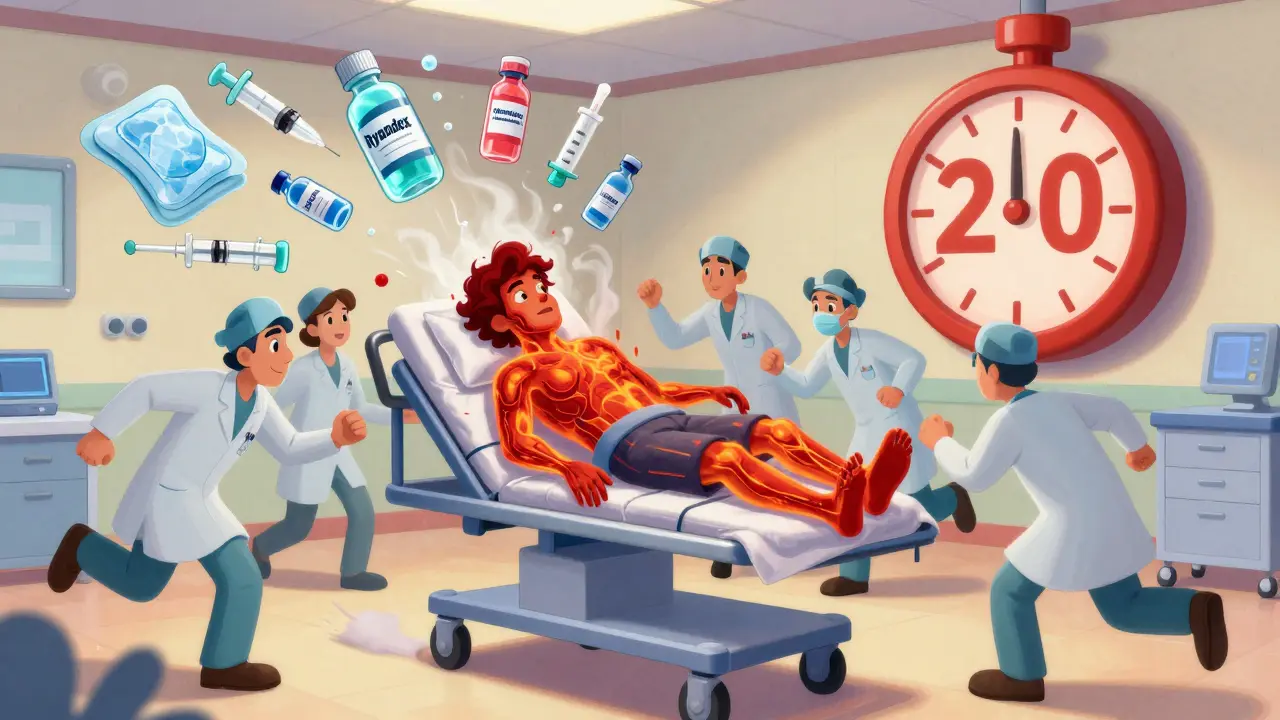
Dantrolene is the key, but it’s not the only thing. Once MH is suspected, the team must:- Stop all triggering anesthetics immediately
- Switch to 100% oxygen at 10 liters per minute
- Hyperventilate to flush out CO2
- Start cooling the patient-ice packs on neck, armpits, groin, cold IV fluids
- Treat high potassium with insulin and glucose
- Give sodium bicarbonate to fix acidosis
- Use mannitol and furosemide to protect kidneys from muscle breakdown products
Without these steps, dantrolene alone won’t save them. The body is in full meltdown. Cooling, breathing, and chemistry correction are all part of the same rescue.
How Fast Do You Need to Act?
Time is everything. If dantrolene is given within 20 minutes of the first sign, survival rates jump to nearly 100%. If it’s delayed beyond 40 minutes, mortality climbs to 50%. That’s why the Malignant Hyperthermia Association of the United States (MHAUS) runs a 24/7 hotline (1-800-644-9737). Anesthesiologists anywhere in North America can call for real-time guidance during a crisis.At Mayo Clinic, they installed MH carts with dantrolene, water, syringes, and cooling gear within 30 seconds of every operating room. Before 2015, it took an average of 22 minutes to start treatment. After the carts, it dropped to 4.7 minutes. Mortality in their system fell to near zero.
Why Do Some Hospitals Still Fail?
The problem isn’t lack of knowledge. It’s lack of preparedness. A 2022 survey found that only 63% of rural surgical centers follow full MH protocols. Academic hospitals? 100%. Why? Because they train staff annually with simulation drills. Residents need at least three MH simulations before they can reliably spot the signs.Many facilities don’t have the budget for $144,000 worth of dantrolene. Others don’t have staff trained to use it. And some still don’t know that the old “family history” screening is outdated. A patient can be perfectly healthy, have no relatives with MH, and still be genetically susceptible.
That’s why the American Society of Anesthesiologists now requires all facilities performing general anesthesia to have an MH emergency kit. It’s not optional. It’s a standard of care.

What’s Next for MH?
The future is moving fast. In 2023, the FDA approved a new intranasal dantrolene formulation for pre-hospital use-expected to hit the market in mid-2024. That means paramedics could start treatment before the patient even reaches the hospital.Genetic testing for RYR1 mutations is now available through 27 U.S. labs. The test costs $1,200-$2,500 and is 95% accurate for known mutations. Some families with a history of MH now get tested before surgery. But it’s not perfect. Not all mutations are known. And insurance doesn’t always cover it.
Researchers are testing new drugs like S107, which stabilizes the ryanodine receptor. And long-term, CRISPR gene editing could one day correct the mutation itself. Phase I trials are expected by 2027.
Meanwhile, anesthesia systems like Epic are now using AI to detect MH in real time. If a patient’s CO2, heart rate, and temperature all spike together, the system automatically alerts the team. No more waiting for someone to notice.
What Should You Do If You’re Scheduled for Surgery?
If you’ve never heard of MH, you’re not alone. But here’s what you can do:- Ask if the facility has an MH emergency kit and how often staff train for it.
- Ask if they use Ryanodex or Dantrium.
- If you have a family history of unexplained anesthesia deaths or muscle disorders, mention it.
- Know the signs: rapid heart rate, stiff jaw, rising CO2, high temperature.
- Don’t assume you’re safe because you’ve had anesthesia before.
Most importantly: if you’re a parent of a child having surgery, ask if the team is trained for MH. Tonsillectomies are one of the most common triggers in kids. And they’re also one of the most common surgeries performed.
Final Thought: It’s Not a Myth. It’s a Medical Emergency.
Malignant hyperthermia isn’t a rare curiosity. It’s a time-sensitive medical emergency that kills when ignored. But it’s also one of the most treatable-if you’re ready. The tools exist. The protocols are clear. The drugs are available. What’s missing is awareness.Every patient deserves a team that knows what to do when the unthinkable happens. And every hospital that performs anesthesia has a responsibility to be ready.
Can malignant hyperthermia happen to someone who’s had anesthesia before without issues?
Yes. MH is genetic, not acquired. Many people have no symptoms until their first or second exposure to triggering anesthetics. Up to 30% of cases occur in patients with no known family history. That’s why doctors can’t rely on past surgeries as proof of safety.
Is malignant hyperthermia hereditary?
Yes, in most cases. About 70% of MH-susceptible individuals carry a mutation in the RYR1 gene, which is inherited in an autosomal dominant pattern. That means if one parent has the mutation, each child has a 50% chance of inheriting it. But not everyone with the mutation will react-environmental triggers are needed.
What anesthesia drugs trigger malignant hyperthermia?
The main triggers are volatile inhalational anesthetics like sevoflurane, desflurane, and isoflurane, and the muscle relaxant succinylcholine. Nitrous oxide, propofol, ketamine, and local anesthetics are safe and do not trigger MH. Always inform your anesthesiologist if you or a family member has had MH or a suspicious reaction.
How do hospitals prepare for malignant hyperthermia?
Hospitals must maintain an MH emergency cart stocked with at least 36 vials of dantrolene (Ryanodex preferred), sterile water, syringes, cooling supplies, and blood gas equipment. Staff must undergo annual simulation training. The MHAUS hotline (1-800-644-9737) is available 24/7 for real-time guidance during a crisis.
Can you be tested for malignant hyperthermia before surgery?
Yes. Genetic testing for RYR1 and CACNA1S mutations is available through certified labs and costs $1,200-$2,500. A muscle biopsy test called the caffeine-halothane contracture test (CHCT) is also used, especially in Europe. Testing is recommended for those with a family history of MH or unexplained anesthesia reactions.
What happens after surviving malignant hyperthermia?
Recovery can take days to weeks. Patients are monitored in intensive care for complications like kidney failure, heart rhythm issues, and ongoing muscle breakdown. They’re advised to avoid triggering anesthetics for life and should wear a medical alert bracelet. Genetic counseling and testing for family members are strongly recommended.