
Acute Angle-Closure Glaucoma Risk Estimator
Step 1: Select Your Profile Factors
Click on the factors that apply to you. Each factor increases your theoretical susceptibility.
Age Over 40
Lens thickens with age, crowding the drainage angle.Asian Ancestry
Shallower anterior chambers are more common in East Asian populations.Farsightedness
Hypermetropia often correlates with shorter eyes and narrower angles.Family History
Parents or siblings with narrow angles or glaucoma.Step 2: Medication Exposure Check
Do you currently take any of these high-risk medications?
- Adrenergic Agents (e.g., Phenylephrine nasal spray)
- Anticholinergics (e.g., Amitriptyline, Tropicamide drops)
- Sulfonamides (e.g., Topiramate)
- SSRIs / Antidepressants (e.g., Paroxetine)
- Antihistamines (e.g., Diphenhydramine/Benadryl)
Risk Assessment Result
Your vision doesn't just fade away in most cases of Acute Angle-Closure Glaucoma (AACG). It attacks. One minute you are fine; the next, your eye is throbbing with pain so severe it feels like someone is drilling into your skull. You see rainbow halos around streetlights. Your stomach turns, and you vomit. If you think this is a migraine or food poisoning, you might be making a mistake that costs you your sight. This is not a gradual decline. It is a medical emergency triggered by something as common as an allergy pill, a nasal spray, or even routine eye drops.
This condition, specifically when induced by medications, accounts for roughly 10-15% of all acute angle-closure cases globally. According to data from the Medsafe Prescriber Update, if this pressure spike isn't treated within 24 to 72 hours, permanent blindness can occur. But the window for saving your optic nerve is often much shorter-just 6 to 12 hours before irreversible damage begins. Understanding which drugs trigger this crisis and recognizing the signs early is the only way to prevent this preventable disaster.
How Medications Trigger an Eye Crisis
To understand why a simple pill can blind you, you have to look at the plumbing of your eye. Inside every eye, fluid called aqueous humor is constantly produced and drained out through a drainage angle. In most people, this angle is wide open. But in about 3.8% of White populations and 8.5% of Asian populations, this angle is naturally narrow. These individuals are anatomically predisposed to trouble, but they live perfectly normal lives until a specific medication tips the balance.
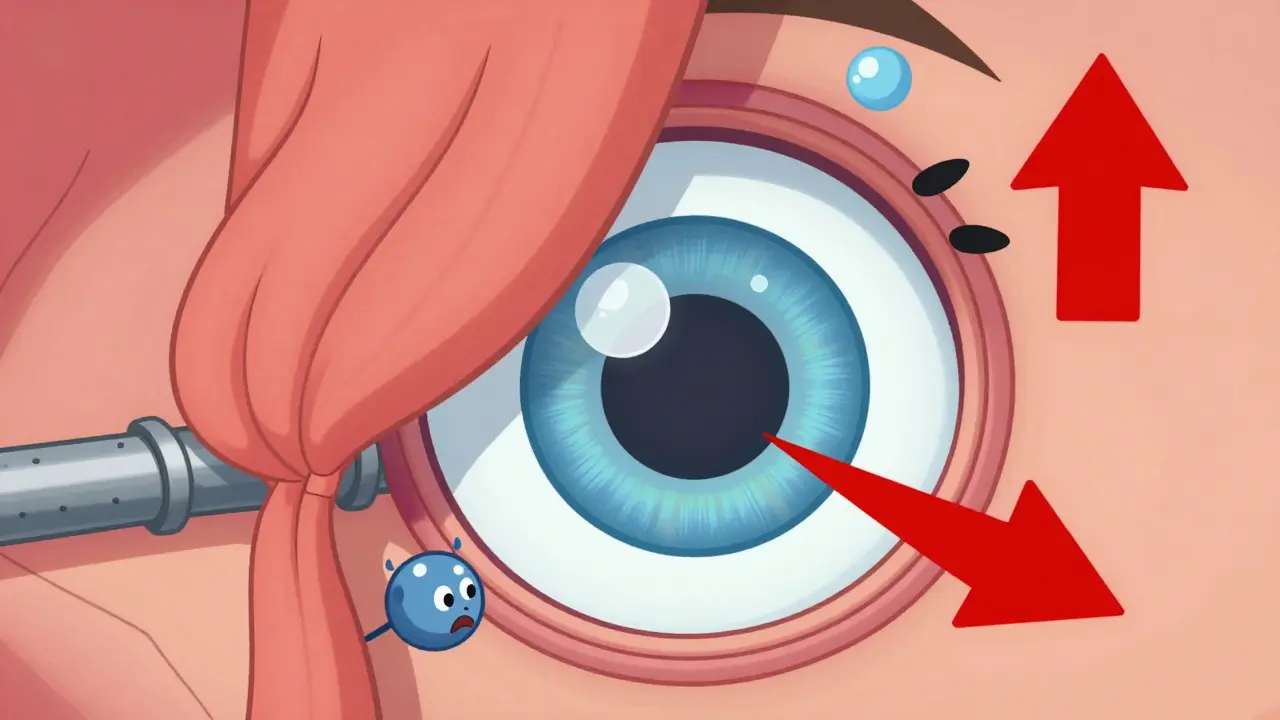
When you take certain drugs, they cause your pupil to dilate (widen). Imagine a curtain being pulled back in a dark room. As the iris (the colored part) moves outward, it bunches up in the corner where the drainage channel sits. In a person with narrow angles, this bunched-up tissue physically blocks the drain. Fluid keeps pumping in, but it cannot get out. Pressure builds rapidly. Normal intraocular pressure (IOP) is between 10 and 21 mm Hg. In drug-induced AACG, this number can skyrocket to 40-80 mm Hg. This pressure crushes the optic nerve fibers, leading to immediate vision loss.
| Medication Class | Common Examples | Mechanism of Action | Risk Level |
|---|---|---|---|
| Adrenergic Agents | Phenylephrine, Ephedrine | Pupil dilation causing pupillary block | High (35% of cases) |
| Anticholinergics | Tropicamide, Amitriptyline | Iris swelling and pupil dilation | High (28% of cases) |
| Sulfonamides | Topiramate, Acetazolamide | Ciliary body edema (swelling) | Moderate (15% of cases) |
| SSRIs / Antidepressants | Paroxetine, Sertraline | Subtle pupil changes and inflammation | Moderate (12% of cases) |
| Antihistamines | Diphenhydramine, Pseudoephedrine | Pupil dilation and mild anticholinergic effect | Moderate (10% of cases) |
The most frequent culprit is phenylephrine, found in many over-the-counter nasal decongestants and redness-relief eye drops. It causes 35% of documented drug-induced cases. Anticholinergics, such as tropicamide used during eye exams or amitriptyline prescribed for sleep or depression, account for another 28%. Even SSRIs, widely considered safe, carry a risk because they can subtly alter pupil dynamics in susceptible eyes.
Recognizing the Symptoms Before It’s Too Late
You cannot feel your intraocular pressure rising. But you can feel the consequences. The symptoms of acute angle-closure glaucoma are distinct and violent. They do not creep up on you gently; they hit hard.
- Severe Eye Pain: Not a headache, but deep, boring pain inside or behind the eye.
- Halos Around Lights: Due to corneal edema (swelling), lights appear surrounded by rainbows. This is a classic hallmark sign.
- Nausea and Vomiting: The vagus nerve connects the eye to the stomach. High eye pressure triggers intense nausea, often leading ER doctors to misdiagnose patients with migraines or gastrointestinal issues.
- Blurred Vision: Sudden, significant drop in visual clarity.
- Red Eye: The conjunctiva becomes hyperemic (deeply red) due to congestion.
- Fixed, Mid-Dilated Pupil: The pupil stays stuck in the middle range (4-6 mm) and does not react to light.
If you experience these symptoms after taking a new medication or even an old one you’ve tolerated before, do not wait. Do not take aspirin and lie down. Go to the nearest emergency department immediately. Tell them explicitly: "I suspect acute angle-closure glaucoma." This phrase alone can save hours of diagnostic delay.
Who Is at Risk? Anatomical Red Flags
Not everyone who takes pseudoephedrine will lose their vision. The danger lies in the combination of the drug and your anatomy. You are at high risk if you have:
- Hypermetropia (Farsightedness): Farsighted eyes are typically shorter front-to-back, pushing the lens closer to the iris and narrowing the angle.
- Asian Ethnicity: East Asian populations have a 2.2 times higher risk than Caucasians due to shallower anterior chambers. Narrow angles are present in 8.5% of Asians versus 3.8% of Whites.
- Age Over 40: The lens thickens with age, further crowding the drainage angle.
- Family History: Genetics play a role. If your parents had narrow angles or glaucoma, you likely do too.
- Shallow Anterior Chamber: Measured by ultrasound biomicroscopy, a depth of less than 2.5 mm is a critical warning sign.
Dr. E.Y. Ah-kee, a leading researcher in this field, notes that most attacks occur in subjects unaware they are at risk. Only 25% of patients know they have narrow angles before the attack happens. This ignorance is dangerous. Many primary care physicians do not screen for eye anatomy before prescribing high-risk meds.

Immediate Treatment and Prevention Strategies
Time is vision. Once you are in the hospital, the goal is to lower the pressure immediately to stop optic nerve death. The standard protocol involves three steps:
- Medical Therapy: Doctors administer pilocarpine eye drops (to constrict the pupil and pull the iris away from the drain) and systemic medications like intravenous mannitol or acetazolamide to reduce fluid production.
- Laser Peripheral Iridotomy (LPI): Within 24 hours, an ophthalmologist uses a laser to create a tiny hole in the iris. This allows fluid to bypass the blocked angle, equalizing pressure. This is the definitive treatment for pupillary block.
- Monitoring: After the acute phase, you must avoid the triggering medication forever. For sulfonamide-induced cases, the mechanism is different (ciliary body swelling), so LPI may not help, and steroid treatments are required instead.
Prevention is far superior to cure. If you know you have narrow angles, you must carry a medical alert card or note in your phone. Before any doctor prescribes you an anticholinergic, adrenergic, or sulfa-based drug, you must say: "I have narrow eye angles and am at risk for angle-closure glaucoma."
Ask for alternatives. Instead of diphenhydramine for allergies, ask for loratadine. Instead of epinephrine for asthma, ask for selective beta-2 agonists like formoterol. These swaps are simple but life-saving.
The Gap in Healthcare Screening
Despite the severity of this condition, screening remains inconsistent. A 2023 survey by the American Academy of Ophthalmology found that only 42% of primary care physicians routinely screen for glaucoma risk before prescribing high-risk medications. Furthermore, 68% of patients report receiving inadequate counseling about these risks.
The solution lies in better technology and awareness. Optical Coherence Tomography (OCT) can now detect narrow angles with 94% sensitivity. Gonioscopy, a specialized exam using a lens to view the drainage angle, should be performed on all patients over 40 before starting high-risk therapies. It takes only 5-7 minutes per eye. If your Shaffer grading score is 2 or lower, you have narrow angles. Document this. Share it with every doctor you see.
We are seeing progress. Integrated health networks like Kaiser Permanente have reduced medication-induced AACG cases by 75% through strict electronic health record alerts. When a pharmacist tries to fill a prescription for phenylephrine for a patient flagged with narrow angles, the system blocks it. We need this level of vigilance everywhere.
Can over-the-counter cold medicine cause blindness?
Yes, if you have narrow eye angles. Decongestants containing phenylephrine or pseudoephedrine can dilate the pupil, blocking fluid drainage in the eye. This causes acute angle-closure glaucoma, a pressure spike that can lead to permanent blindness within 24-72 hours if untreated. People with farsightedness or Asian ancestry are at higher risk.
What is the difference between open-angle and angle-closure glaucoma?
Open-angle glaucoma is chronic and silent; the drainage angle is open but clogged, causing slow pressure rise over years. Angle-closure glaucoma is acute and painful; the drainage angle is physically blocked by the iris, causing rapid pressure spikes that constitute a medical emergency requiring immediate laser treatment.
Which antidepressants are safest for people with narrow angles?
Tricyclic antidepressants (like amitriptyline) and some SSRIs (like paroxetine) have anticholinergic properties that can trigger angle closure. Safer alternatives may include bupropion or mirtazapine, which have lower anticholinergic activity. Always consult an ophthalmologist before starting psychiatric medication if you have known narrow angles.
How long does it take for vision loss to become permanent in acute glaucoma?
Irreversible optic nerve damage can begin within 6 to 12 hours of symptom onset. If intraocular pressure remains above 40 mm Hg for more than 24 hours, permanent visual field loss is highly likely. Immediate emergency care is critical to preserve vision.
Can eye drops used during an eye exam cause angle closure?
Yes. Dilating drops like tropicamide or phenylephrine are common triggers. This is why ophthalmologists check your eye angles (gonioscopy) before performing dilated exams, especially in older patients or those with farsightedness. If you develop pain or halos after an eye exam, seek emergency care immediately.