
Imagine buying a bottle of heart medication, storing it exactly as the label says, and finding out six months later that half the active ingredient has turned into useless chemical sludge. That is not just a hypothetical nightmare; it is a real risk that stability testing is designed to prevent. This process is the silent guardian behind every expiration date on your medicine cabinet. It is the systematic way manufacturers prove their drugs stay safe, effective, and pure from the moment they leave the factory until the day you take them.
We often think of quality control as something that happens during production-checking the mix, verifying the fill weight, sealing the blister pack. But the job doesn't end there. The true test begins after the product is manufactured and packaged. Stability testing is long-term quality monitoring post-manufacture. It answers one critical question: How does time, temperature, and light affect this specific drug in its specific container? Without this data, we would have no scientific basis for telling patients how long their medicine will last.
The Science Behind the Expiration Date
Why do drugs expire? Chemicals are rarely static. Over time, they react with oxygen, moisture, or even the plastic of their own packaging. An antibiotic might lose potency, becoming ineffective against infection. A painkiller might break down into compounds that irritate the stomach. Stability testing tracks these changes by placing samples of the finished product into controlled environments and analyzing them at regular intervals.
The framework for this work comes from the International Council for Harmonisation (ICH), a collaboration between regulators and industry experts from Europe, Japan, and the United States. Their guidelines, particularly ICH Q1A(R2), set the global standard. They define what conditions to use, how often to test, and what results mean "failure." For most new drugs, this means running tests over two to three years. Yes, you read that right. Before a new medicine hits the market, companies must wait up to 36 months to gather enough data to prove it stays stable.
This isn't just bureaucracy. In 2021, the FDA reported that 17.3% of all drug recalls were linked to stability issues. These weren't minor labeling errors; they were cases where drugs lost potency or developed harmful degradation products because the stability profile wasn't fully understood or monitored correctly. Stability testing is the bridge between a successful lab experiment and a reliable patient treatment.
How Stability Chambers Work: Real-Time vs. Accelerated
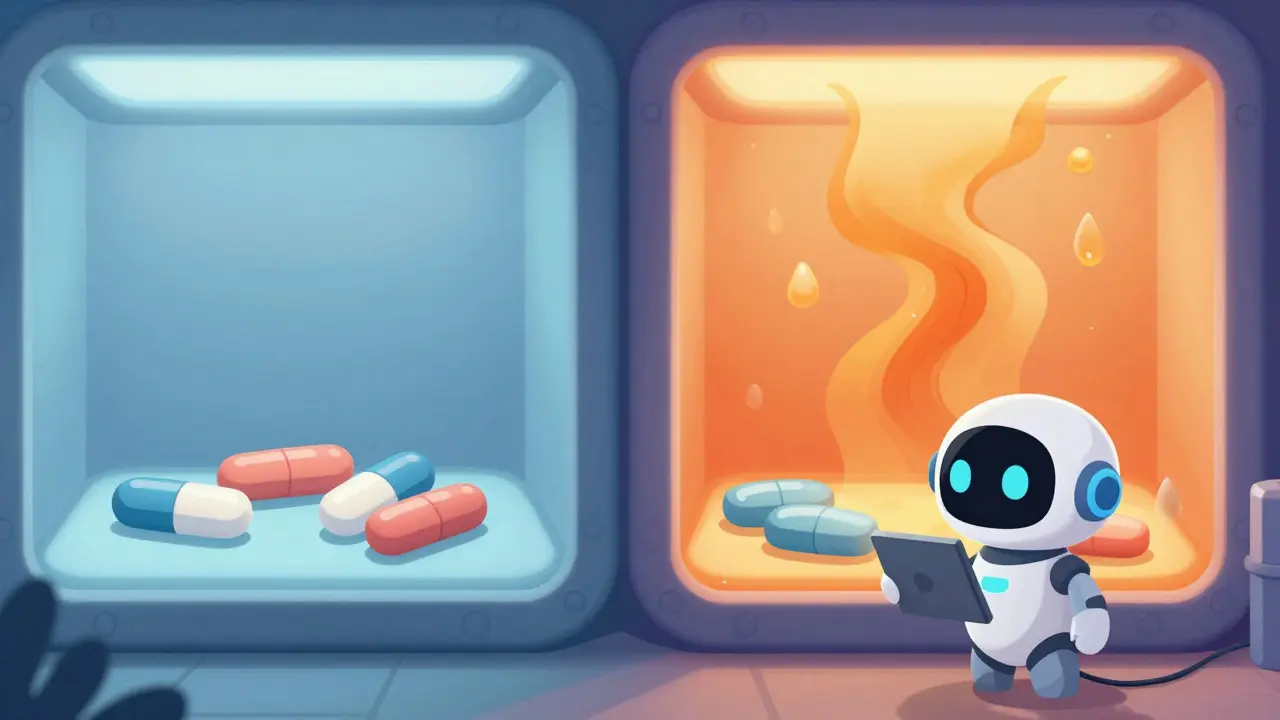
If you walk into a modern pharmaceutical quality lab, you’ll see rows of stainless-steel chambers humming quietly. These are stability chambers, and they are the heart of the operation. Inside, the environment is locked down with military precision. Temperature and humidity are monitored 24/7, with alarms triggering if conditions drift even slightly outside the allowed range.
There are two main types of testing happening inside these boxes:
- Long-term (Real-time) Testing: This mimics actual storage conditions. For temperate climates like the US or Western Europe, this usually means 25°C ± 2°C and 60% relative humidity (RH). Samples are tested at 0, 3, 6, 9, 12, 18, 24, and sometimes 36 months. This data provides the definitive shelf life.
- Accelerated Testing: Here, conditions are harsher-typically 40°C ± 2°C and 75% RH. The goal is to stress the product and force degradation to happen faster. If a drug survives six months under these intense conditions without breaking down significantly, it gives scientists early confidence about its stability. However, accelerated data alone cannot determine the final expiration date for most products.
For products destined for hot, humid regions, the standards shift to 30°C ± 2°C and 65% RH. Every variable matters. Even light exposure is tested separately under ICH Q1B guidelines, exposing samples to specific levels of visible and UV light to ensure the packaging protects the drug from sunlight.
What Actually Gets Tested?
It’s not enough to just look at the pill and say, "It looks fine." Stability testing requires rigorous analytical chemistry. Scientists evaluate multiple attributes to build a complete picture of the product's health over time.
| Parameter Type | Specific Tests | Why It Matters |
|---|---|---|
| Chemical | Assay (potency), Degradation products, pH | Ensures the drug delivers the correct dose and hasn't broken down into toxic byproducts. |
| Physical | Appearance, Color, Hardness, Dissolution rate | A change in color might indicate oxidation. Slow dissolution could mean the drug won't absorb properly in the body. |
| Microbiological | Sterility, Bioburden, Preservative efficacy | Critical for liquids and injectables to prevent bacterial growth. |
| Packaging Interaction | Moisture barrier integrity, Gas permeability | Checks if the bottle or blister pack is keeping air and water out effectively. |
All analytical methods used must be "stability-indicating," meaning they can clearly separate the active ingredient from any impurities that form over time. This validation is governed by ICH Q2(R1). If the test method itself isn't robust, the stability data is worthless.
The Cost of Compliance and Common Pitfalls
Running a stability program is expensive. Major pharmaceutical companies spend between $500,000 and $2 million annually on infrastructure alone. Individual studies can cost $50,000 to $150,000 per formulation. Why such a high price tag? Because the stakes are incredibly high.
One common pitfall is equipment failure. Stability chambers are complex machines. If a cooling unit fails on a Tuesday night, the temperature might spike. If that excursion isn't caught immediately, months of data could be invalidated. I’ve seen companies lose eight months of progress-and millions of dollars in delayed market entry-because of a single humidity sensor malfunction. That’s why chamber qualification and quarterly temperature mapping are non-negotiable requirements under USP Chapter 1079.
Another challenge is data management. With thousands of samples being tested across multiple sites, keeping track of everything manually is impossible. The industry is rapidly moving toward electronic stability data management systems. According to the Parenteral Drug Association, these systems reduce data review time by 55%. But implementing them takes effort; validating an electronic system to meet regulatory standards can take six to nine months.
Then there’s the human element. When a result falls outside specifications-an Out-of-Specification (OOS) result-it triggers a formal investigation. You can’t just discard the bad sample and retest. Regulatory agencies like the FDA demand a root cause analysis. Was it a lab error? Or did the product actually fail? Getting this wrong can lead to warning letters or rejected drug applications.

Future Trends: AI and Continuous Manufacturing
The field is evolving. Traditional stability testing is slow. Waiting three years for data holds back innovation. Enter artificial intelligence and machine learning. Companies are now using predictive modeling to simulate degradation pathways. The Pharmaceutical Research and Manufacturers of America (PhRMA) predicts that AI could cut stability testing timelines by 30-40% by 2027. Instead of waiting for a reaction to happen in a chamber, algorithms analyze historical data to predict when and how a drug might degrade.
Another major shift is continuous manufacturing. Unlike traditional batch processing, where you make a huge vat of drug and then test it, continuous manufacturing produces drug product in a steady stream. The FDA’s 2023 draft guidance and the finalized ICH Q13 guideline address how to handle stability in this context. It moves the focus from testing finished batches to real-time monitoring throughout the process. This approach promises faster production and potentially more consistent quality, but it requires entirely new stability protocols.
Risk-based approaches are also gaining traction. Under ICH Q12 principles, companies can apply for lifecycle management changes. If a drug has been on the market for years with a perfect stability record, regulators may allow reduced testing frequencies or smaller sample sizes. One mid-sized generics company reported saving $120,000 annually per product by implementing these principles, proving that smart regulation can reduce costs without compromising safety.
Why This Matters to You
You might wonder why you should care about stability chambers and ICH guidelines. The answer is simple: trust. When you pick up a prescription, you trust that the doctor’s dosage instructions will work. You trust that the pill hasn’t degraded into something harmful. Stability testing is the evidence behind that trust. It ensures that whether you buy a generic blood pressure med or a brand-name biologic, the quality remains consistent from the first bottle to the last.
As the market grows-with the global stability testing services sector projected to reach $4.93 billion by 2028-the rigor of these processes will only increase. New biologics and personalized medicines present unique stability challenges, requiring even more sophisticated monitoring. But the core mission remains unchanged: protecting patient safety through scientific vigilance long after the manufacturing line stops.
How long does stability testing typically take?
For new molecular entities, long-term stability testing usually runs for 24 to 36 months to establish a definitive shelf life. Accelerated testing runs for 6 months to provide early indications of stability, but it cannot replace real-time data for final approval.
What happens if a drug fails stability testing?
If a drug fails, it triggers an Out-of-Specification (OOS) investigation. The manufacturer must determine if the failure was due to a lab error or a genuine product defect. If it’s a product defect, the formulation or packaging may need to be redesigned, which can delay market launch by months or even years.
Do all drugs require the same stability conditions?
No. Conditions depend on the climate zone where the drug will be sold. Temperate zones use 25°C/60% RH, while hot/humid zones use 30°C/65% RH. Biologics and sterile products may have additional specific requirements regarding light and microbial contamination.
Can stability testing be outsourced?
Yes, many companies, especially small biotechs, outsource stability testing to Contract Research Organizations (CROs) like SGS or Eurofins. About 72% of pharmaceutical companies outsource at least part of this work due to the high cost of maintaining compliant in-house facilities.
How does AI impact stability testing?
AI and machine learning are being used to predict degradation pathways based on historical data. This predictive modeling could reduce testing timelines by 30-40% by allowing scientists to anticipate stability issues earlier in the development process, though regulatory acceptance is still evolving.