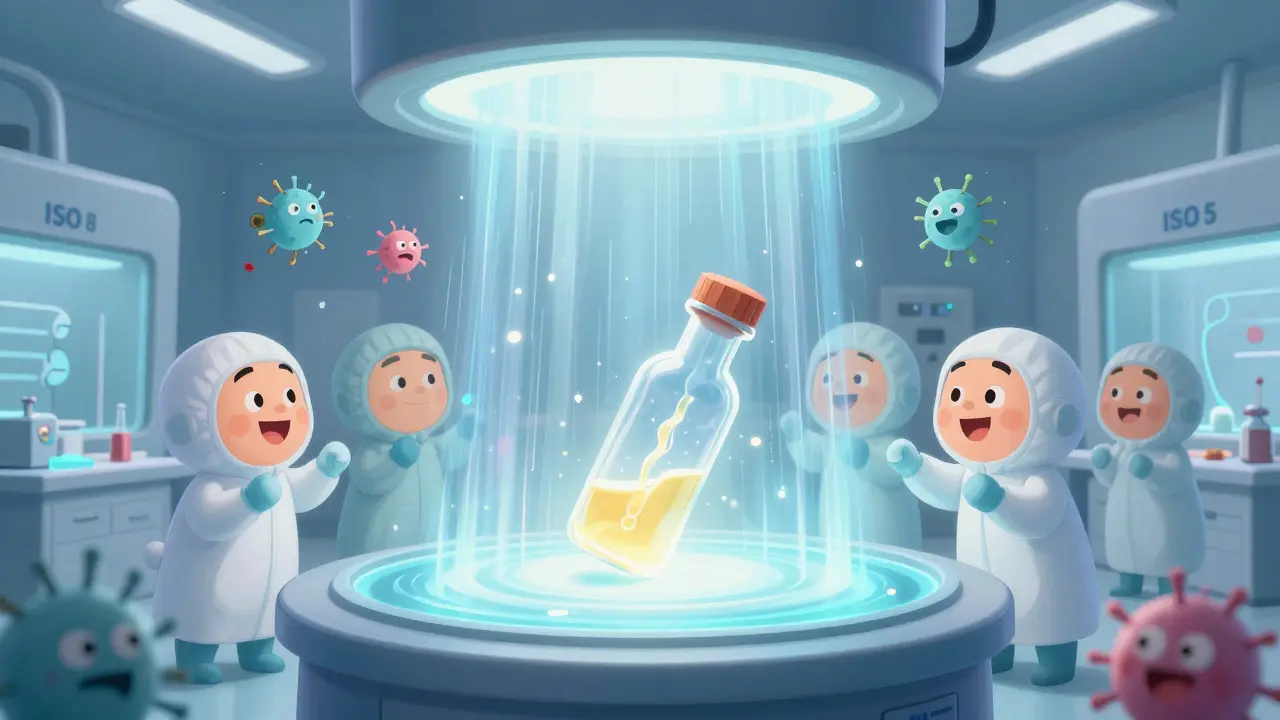
When a drug goes directly into your bloodstream, there’s no second chance. No stomach acid to kill contaminants. No immune system waiting at the gate. That’s why sterile manufacturing for injectables isn’t just about cleanliness-it’s about survival. A single microbe in a vial can trigger sepsis, organ failure, or death. The 2012 meningitis outbreak linked to contaminated steroid injections killed 64 people and sickened over 750. That wasn’t a lab error. It was a failure in sterile manufacturing systems that should have been impossible.
Why Sterile Manufacturing Is Non-Negotiable
Oral pills pass through the digestive system. Skin creams sit on the surface. But injectables bypass every natural defense. That’s why the standard for sterility isn’t "clean enough"-it’s sterility assurance level (SAL) of 10^-6. That means no more than one contaminated unit in a million. The World Health Organization set this in 2011, and regulators worldwide enforce it. The FDA, EU, and other agencies don’t treat this as a suggestion. It’s a legal requirement.This isn’t new. The 1955 Cutter Laboratories polio vaccine incident, where improperly inactivated virus killed children, forced the first federal sterile manufacturing rules. The 1920s insulin contamination deaths did the same. These weren’t isolated mistakes. They were system failures. Today, the stakes haven’t changed-only the tools.
Two Paths to Sterility: Terminal vs. Aseptic Processing
There are only two ways to make sterile injectables: terminal sterilization and aseptic processing. Each has trade-offs.Terminal sterilization means you fill the vial, seal it, then blast it with steam at 121°C for 15-20 minutes-or use gamma radiation. This kills everything. It’s the gold standard because it’s proven, repeatable, and gives you a SAL of 10^-12, far beyond the required 10^-6. But here’s the catch: 60-70% of modern injectables can’t survive this. Biologics like monoclonal antibodies, vaccines, and gene therapies are proteins or living cells. Heat or radiation destroys them. So for these, you need aseptic processing.
Aseptic processing means assembling the product in a sterile environment without heat. Every step-from filling to capping-happens under conditions so clean they’d make a cleanroom engineer blush. This is where things get complex. You need isolators or RABS (Restricted Access Barrier Systems) that maintain ISO 5 air quality. That’s fewer than 3,520 particles per cubic meter that are 0.5 microns or larger. For context, a typical office has over 10 million particles per cubic meter.
The Cleanroom Hierarchy: From Gowning to Filling
Sterile manufacturing doesn’t happen in one room. It’s a chain of controlled environments.- ISO 8 (Class 100,000): Gowning area. Staff put on sterile suits here.
- ISO 7 (Class 10,000): Intermediate buffer zones. Equipment is transferred here.
- ISO 5 (Class 100): The fill area. Where the vial gets filled. This is the heart of the operation.
Airflow is tightly controlled. In ISO 5 zones, air moves at 0.3-0.5 meters per second in a laminar, unidirectional flow-like a silent waterfall of clean air. Pressure differences between rooms are kept at 10-15 Pascals to prevent dirty air from creeping in. Temperature? 20-24°C. Humidity? 45-55%. Too dry, and static electricity attracts particles. Too humid, and microbes thrive.
Water isn’t just purified-it’s Water for Injection (WFI). It must have endotoxin levels below 0.25 EU/mL. That’s stricter than drinking water standards by a factor of 1,000. Glass vials and rubber stoppers are depyrogenated at 250°C for 30 minutes. That’s not just cleaning-it’s incinerating the heat-resistant toxins from dead bacteria.
Testing for Failure Before It Happens
You can’t test every vial for sterility after production. It would take weeks, and by then, the batch is already shipped. So you test the process instead.Media fill simulations are the most critical test. You run the entire filling process using nutrient broth instead of the actual drug. Then you incubate the vials for 14 days. If any grow microbes, the whole process fails. The FDA requires at least 5,000-10,000 units per simulation. A failure rate above 0.1% means your training, equipment, or procedure is broken.
Real-time monitoring is now mandatory. In ISO 5 zones, particle counters run continuously. Air samplers catch microbes every hour. Alert levels are set at 1 CFU/m³. Action levels at 5 CFU/m³. Go over that, and production stops. No exceptions. In 2023, a top pharmaceutical company lost $450,000 in one batch because a glove in their RABS system had a microscopic tear. That’s how sensitive this is.
Costs, Risks, and the Hidden Price of Sterility
Building a sterile injectable facility isn’t cheap. A small-scale operation (5,000-10,000 liters per year) costs $50-100 million. Aseptic processing runs 2-3 times more expensive than terminal sterilization. Why? Isolators cost 40% more than RABS. Continuous monitoring systems add six figures. Staff need 40-80 hours of training per year, plus semi-annual media fill qualifications.And then there’s the cost of failure. A single sterility test failure averages $1.2 million in lost product, retesting, regulatory penalties, and reputational damage. In 2022, 68% of FDA inspection deficiencies in sterile facilities were linked to aseptic technique failures. Only 12% were about terminal sterilization. That tells you where the real risk lies.
But the biggest cost isn’t financial-it’s human. One contaminated vial can kill. That’s why companies like Lonza in Switzerland invested in continuous monitoring. The result? A 45% drop in deviations and 30% faster batch releases. Automation isn’t a luxury anymore. It’s survival. One facility cut its defect rate from 0.2% to 0.05% by switching to automated visual inspection-spending $2.5 million upfront. It paid off.

Regulations Are Getting Tighter
The EU’s revised Annex 1 (2022) changed everything. No more periodic air sampling. You need continuous monitoring. Quality Risk Management (ICH Q9) is now mandatory. The FDA followed in 2023 with new guidance pushing for advanced process controls and closed systems.Closed processing-where materials move through sealed, automated lines without human contact-is now used in 65% of new facilities. It cuts contamination risk by removing the biggest variable: people. Even with training, humans are the leading cause of contamination. Gloves tear. Hair falls. Breaths carry microbes.
Contract manufacturers now handle 55% of sterile injectable production. Companies like Catalent, Lonza, and Thermo Fisher dominate. But even they aren’t immune. Only 28 of 1,200 Chinese sterile facilities passed FDA inspections in 2022. Regulatory standards are global-and unforgiving.
What’s Next? Automation, AI, and Faster Testing
The future of sterile manufacturing isn’t bigger cleanrooms. It’s smarter systems.- Robotic filling is projected to grow 40% by 2027. Machines don’t get tired. They don’t sneeze.
- Rapid microbiological methods are replacing 14-day incubation tests. New tech gives results in 24 hours.
- Digital twins simulate entire production lines in software before you build them. You can test failures virtually.
- AI-driven inspections are coming. The FDA plans to use machine learning to spot patterns in data before problems occur.
By 2028, the sterile injectables market will hit $350 billion. But only companies that invest in modern systems will survive. The old ways-manual filling, batch testing, paper records-are disappearing. The new standard is real-time data, closed systems, and zero tolerance.
Final Reality Check
Sterile manufacturing for injectables isn’t about being perfect. It’s about proving you’ve eliminated every possible path to failure. Every glove, every valve, every air filter, every person entering the room-they’re all part of the equation.If you’re a patient, you should never have to wonder if your injection is safe. If you’re a manufacturer, you can’t afford to wonder either. The science, the regulations, the technology-all of it exists to make sure that when a needle goes in, the only thing entering your body is the medicine. Nothing else.
What is the difference between terminal sterilization and aseptic processing?
Terminal sterilization kills microbes after the product is sealed, using heat or radiation. It’s reliable but only works for products that can handle high temperatures, like saline solutions. Aseptic processing keeps everything sterile during manufacturing without using heat. It’s required for fragile drugs like biologics and monoclonal antibodies, but it demands extreme environmental controls and constant monitoring.
Why is ISO 5 the most critical cleanroom class for injectables?
ISO 5 is the environment where the sterile product is filled into containers. It must have fewer than 3,520 particles per cubic meter that are 0.5 microns or larger. This is the last point of contact before the product is sealed. Any contamination here becomes part of the final product. That’s why air flow, pressure, and particle counts are monitored continuously in ISO 5 zones.
What are media fill simulations, and why are they required?
Media fill simulations replicate the entire aseptic filling process using nutrient broth instead of the actual drug. After filling, the vials are incubated for 14 days to see if any microbes grow. If they do, the process failed. These tests prove that your procedure, equipment, and personnel can maintain sterility under real conditions. The FDA requires at least 5,000-10,000 units per simulation to be statistically meaningful.
How do regulations like EU GMP Annex 1 affect sterile manufacturing?
EU GMP Annex 1 (2022) made continuous environmental monitoring mandatory, replacing periodic checks. It also requires Quality Risk Management (ICH Q9) to be embedded in every process. This means you can’t just follow a checklist-you must prove you’ve identified and controlled every possible contamination risk. It raised the bar from compliance to true control.
Why are biologics so challenging to manufacture sterility for?
Biologics-like monoclonal antibodies, vaccines, and gene therapies-are large, complex molecules made from living cells. They’re extremely sensitive to heat, radiation, and even mechanical stress. Terminal sterilization would destroy them. So they must be made using aseptic processing, which is far more vulnerable to contamination. This makes their manufacturing more expensive, more complex, and more prone to failure.
What’s the biggest cause of sterility failures in injectable manufacturing?
Human error. Despite training and procedures, people are the leading source of contamination. A torn glove, a sneeze near the fill line, improper gowning-all can introduce microbes. That’s why closed systems and automation are now the industry standard. The fewer humans involved in the process, the lower the risk.