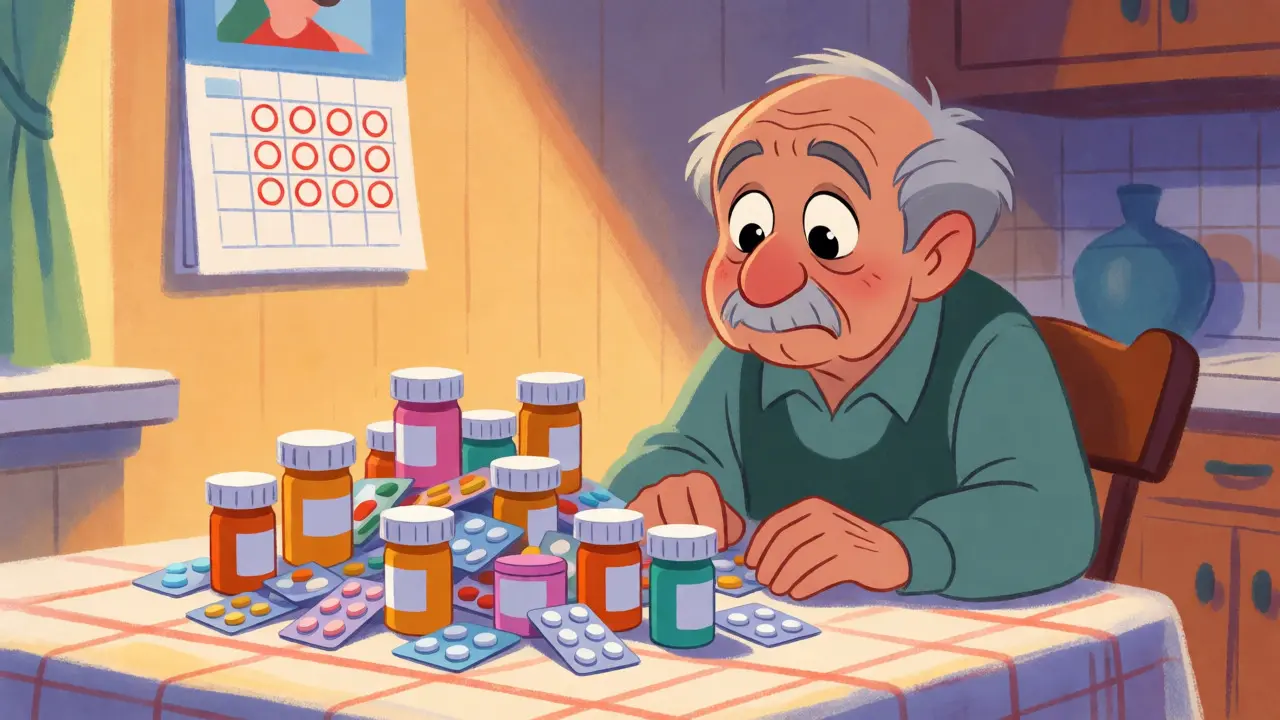
You take your pills. You follow the schedule. Or do you? The World Health Organization estimates that roughly 50% of patients with chronic conditions don't take their medications as prescribed. That’s not just a minor slip-up; it’s a massive gap in care that contributes to an estimated 125,000 deaths annually in the United States alone. If you’ve ever skipped a dose because you were running late, or stopped a prescription because it felt too expensive, you’re part of this statistic. Understanding why we skip meds isn’t about blaming patients for being lazy or forgetful. It’s about recognizing the real, tangible barriers standing between a prescription and actual treatment.
The High Cost of Missing Doses
Nonadherence is expensive. We aren't talking about pocket change here. The National Community Pharmacists Association reports that poor adherence costs the U.S. healthcare system between $100 billion and $300 billion every year. When patients don’t take their heart medication or diabetes drugs correctly, they are more likely to end up in the emergency room, get hospitalized, or need invasive procedures like stents. For example, patients who stick to their antihypertensive regimen are 30% to 45% more likely to keep their blood pressure under control compared to those who don’t. This isn’t theoretical; it’s a direct line from skipping a pill to a higher risk of stroke or heart attack. The problem has been tracked since the 1970s, but it’s getting worse, not better, as our population ages and lives longer with multiple chronic issues.
Practical Barriers: The Day-to-Day Hurdles
Most people assume forgetting is the main culprit, and data backs this up. A 2024 study found that 44% of diabetic patients over 59 cited forgetfulness as a primary reason for missing doses. But "forgetting" is often a symptom of a larger practical problem: complexity. If you take four different medications at three different times of day, your brain has to work hard to manage that routine. Research shows a clear link between dosing frequency and adherence. People taking once-daily medications adhere at a rate of about 79%, while those on four-times-daily regimens drop to 51%. It’s simple math: the more steps required, the higher the chance of failure.
Financial constraints are another huge practical barrier. According to the American Medical Association, half of all patients cite cost as a primary reason for not filling or continuing prescriptions. The CDC notes that 20% to 30% of new prescriptions are never filled at all because of price tags. Imagine being told you need a new drug to prevent a future crisis, but the co-pay is $80 a month. Do you buy groceries or the pill? Many choose groceries, delaying treatment until symptoms become unbearable.

Perceptual Barriers: Doubt and Fear
It’s not always about money or memory. Sometimes, it’s about belief. Professor Rob Horne’s Necessity-Concerns Framework highlights that doubts about whether a treatment is actually necessary account for nearly half of non-adherence cases. If you feel fine, why take a pill for high blood pressure that has no symptoms? This is common in asymptomatic conditions. Patients often think, "I don't feel sick, so I don't need this," failing to understand that the medication is preventing damage happening silently inside their body.
Fear of side effects is the other big perceptual block. About 38% of non-adherent patients worry about adverse reactions. Maybe a friend said statins cause muscle pain, or you read online horror stories about weight gain. These fears can outweigh the benefits in a patient's mind, especially if the doctor didn't take time to explain the actual risk profile. Poor health literacy exacerbates this. If instructions are written in jargon or small print, patients might misunderstand how to take the drug, leading to accidental overdoses or underdosing, which further erodes trust in the treatment.
The Polypharmacy Problem
As we age, we tend to accumulate medications. This is called polypharmacy, and it’s a major adherence killer. Every additional medication increases the likelihood of nonadherence by 16%. It’s not just about swallowing more pills; it’s about managing interactions, remembering specific timing (some with food, some without), and dealing with cumulative side effects. A patient taking five drugs has five potential points of failure. One Reddit user noted, "I have 5 different medications... I miss doses at least twice a week because my work schedule changes constantly." This illustrates how external life factors collide with complex medical needs.
Drug formulation also plays a role. Some pills are large and hard to swallow. Others require refrigeration or special handling. Insulin pens, for instance, have tiny dosage markings that can be difficult for older adults with vision issues to read accurately. These physical hurdles make the daily act of medication-taking frustrating rather than routine.

Solutions That Actually Work
So, what helps? Blaming the patient doesn’t fix anything. Successful interventions address both practical and perceptual barriers simultaneously. Simplifying the regimen is key. Switching from multiple daily doses to long-acting formulations or combination pills (two drugs in one tablet) can boost adherence significantly. For schizophrenia patients, moving from oral meds to long-acting injectables raised adherence rates from 45% to 85%.
Technology offers tools, but they aren't magic bullets. Reminder apps help, but studies show only 32% of independent pharmacies have formal adherence programs, and many older adults struggle with digital interfaces. However, pharmacy-based solutions like medication synchronization-where all refills happen on the same date-have improved adherence by 18%. Automated mail-order prescriptions for 90-day supplies also increase adherence by 15-20% by reducing the hassle of frequent trips to the pharmacy.
Communication is critical. Structured counseling sessions where doctors explicitly discuss necessity and address concerns improve adherence by 25%. It’s not enough to write a prescription; providers need to ask, "What worries you most about taking this?" and "How does this fit into your daily life?" When patients feel heard and understand the 'why,' they are more likely to comply.
| Barrier Type | Specific Factor | Impact on Adherence | Common Solution |
|---|---|---|---|
| Practical | Dosing Frequency | Adherence drops from 79% (once daily) to 51% (four times daily) | Switch to long-acting or combination drugs |
| Practical | Cost | 20-30% of new scripts never filled | Generic alternatives, assistance programs, 90-day supplies |
| Practical | Complexity/Polypharmacy | +16% nonadherence risk per added medication | Medication reconciliation, blister packs |
| Perceptual | Doubts on Necessity | Accounts for ~47% of nonadherence cases | Patient education on silent symptoms/prevention |
| Perceptual | Fear of Side Effects | Accounts for ~38% of nonadherence cases | Open dialogue, monitoring plans, reassurance |
Frequently Asked Questions
Is it okay to stop taking medication if I feel better?
Generally, no. Many chronic conditions like hypertension or depression are managed, not cured, by medication. Feeling better is often proof that the medication is working. Stopping abruptly can lead to rebound effects or a return of symptoms. Always consult your provider before stopping.
What is the best way to remember to take pills?
Linking medication to an existing daily habit (like brushing teeth) is highly effective. Using pill organizers, setting phone alarms, or asking your pharmacist about blister packaging can also help reduce reliance on memory alone.
Does generic medication work as well as brand name?
Yes. The FDA requires generic drugs to have the same active ingredient, strength, dosage form, and route of administration as the brand-name version. They are bioequivalent, meaning they perform the same way in the body, often at a much lower cost, which helps adherence.
How does polypharmacy affect older adults?
Older adults often take multiple medications for various conditions. This increases the risk of drug interactions, side effects, and confusion about schedules. Regular medication reviews with a pharmacist or doctor can help eliminate unnecessary drugs and simplify the regimen.
Can financial aid help with medication costs?
Absolutely. Many pharmaceutical companies offer patient assistance programs, coupons, or discount cards. Pharmacies may also offer generic substitution options. Discussing cost openly with your provider can lead to prescribing more affordable alternatives without sacrificing efficacy.