Picture a hospital pharmacy in Mumbai or a clinic in rural Brazil. The shelves are stocked with medicines that look almost identical to the expensive brand-name drugs you might see in New York or London. But here, they cost a fraction of the price. This is the reality of the global generic drugs market, a sector that has quietly become the backbone of healthcare affordability worldwide. As we move through 2026, this market isn't just surviving; it's evolving into something more complex, more global, and surprisingly more innovative than many people realize.
If you think generics are just cheap copies of old pills, you're missing half the story. The future of this industry lies in a dramatic shift from simple chemical compounds to complex biological imitations, known as biosimilars. It also hinges on the rise of "pharmerging" nations-countries like India, China, and Brazil that are no longer just manufacturing hubs but becoming strategic powerhouses in drug development. Understanding these shifts is crucial for anyone involved in healthcare policy, investment, or patient advocacy.
The Shift From Small Molecules to Biosimilars
For decades, the generic market was dominated by small-molecule drugs. These are conventional medications made through straightforward chemical synthesis. Think of aspirin or metformin. They are easy to manufacture, stable, and incredibly cheap to produce once the patent expires. According to data from Grand View Research in 2024, these conventional drugs still hold the lion's share, representing about 57.56% of the global pharmaceutical market revenue. However, the growth engine is changing.
The new frontier is biosimilars. Unlike small molecules, biologics are large, complex structures made from living cells. Copying them is not like photocopying a document; it's more like trying to recreate a masterpiece painting without seeing the original canvas. Because of this complexity, developing a biosimilar requires 10 to 20 times more manufacturing steps than a traditional generic. The cost reflects this: while a conventional generic might cost $1 to $5 million to develop, a biosimilar can require an investment of $100 to $250 million, according to BCC Research.
This high barrier to entry changes the game. Smaller generic manufacturers often lack the sophisticated facilities needed for biologics. Consequently, the market is consolidating around larger players who can afford the risk. Yet, the reward is significant. While traditional generics are priced 80-85% lower than their branded counterparts, biosimilars typically offer a discount of only 15-30%. This means higher profit margins for manufacturers, even if the volume is lower. By 2030, Mordor Intelligence projects the biosimilar segment will grow at a compound annual growth rate (CAGR) of 12.3%, outpacing traditional generics.
| Feature | Traditional Generics (Small Molecules) | Biosimilars (Large Molecules) |
|---|---|---|
| Manufacturing Complexity | Low (Chemical Synthesis) | High (Living Cell Cultures) |
| Development Cost | $1 - $5 Million | $100 - $250 Million |
| Price Discount vs. Brand | 80 - 85% | 15 - 30% |
| Growth Rate (CAGR) | ~5.7% | ~12.3% |
| Market Share (2024) | 57.56% of Pharma Revenue | Rapidly Expanding Niche |
The Rise of Pharmerging Markets
Geography is playing a bigger role in the generic market than ever before. For years, the narrative was simple: Western companies invented drugs, and Asian countries manufactured them. That dynamic is shifting. We are now witnessing the rise of "pharmerging" markets-a term coined to describe emerging economies with high pharmaceutical growth potential. This group includes India, China, Brazil, Russia, Turkey, and several Southeast Asian nations.
India remains the undisputed king of volume. It produces over 60,000 different generic medicines and supplies roughly 20% of the world's generic drug volume by count. If you take blood pressure medication in the US, there's a good chance the active ingredient came from India. China, on the other hand, dominates the upstream supply chain. According to the U.S. FDA's 2024 Supply Chain Report, China manufactures approximately 40% of the world's Active Pharmaceutical Ingredients (APIs). In fact, 65% of all APIs used in global generic production come from China. This creates a single point of failure that regulators are increasingly worried about.
But it's not just about manufacturing. These countries are also becoming massive consumers. IQVIA estimates that pharmerging markets contributed $112 billion in incremental medicine spending between 2020 and 2024. By 2025, these regions are expected to add another $140 billion in spending. Why? Because governments in these nations are expanding insurance coverage and implementing healthcare reforms. Dr. Rajiv Shah, a Global Health Specialist at the World Bank, noted in 2024 that these nations will play a defining role in global pharmaceutical growth because their populations are aging and facing rising rates of chronic disease, just like in the West.
Pricing Pressures and Profit Squeezes
Here is the uncomfortable truth for generic manufacturers: volume is up, but profits are down. In developed markets like North America, Western Europe, and Japan, growth is sluggish, hovering between 2% and 5% CAGR. The reason? Price controls. Governments and private payers are aggressively cutting prices to manage soaring healthcare costs. Global healthcare expenditure hit $9.8 trillion in 2024, according to WHO data, and officials are desperate to contain it.
In the United States, generics account for 90% of prescriptions but only 23% of pharmaceutical spending. That sounds like a win for affordability, but for manufacturers, it means razor-thin margins. KPMG analysis shows that profit margins for generic manufacturers fell from 18% in 2020 to just 12% in 2024. This squeeze is forcing consolidation. Smaller companies are being bought out or going bankrupt. Dr. Sarah Thompson of KPMG argues that manufacturers must "become bigger, eliminate middlemen, and develop innovative service models" to survive.
Europe presents a fragmented picture. Generic penetration rates vary wildly, from 72% in Germany to just 28% in Italy. This disparity reflects different national reimbursement policies. In countries with strong generic substitution laws, doctors prescribe generics automatically. In others, brand loyalty persists. This inconsistency makes it hard for multinational generic companies to plan long-term strategies.
Supply Chain Vulnerabilities and Quality Control
The global nature of the generic supply chain is its greatest strength and its biggest weakness. When a factory in Gujarat, India, shuts down due to a power outage, or a port in Shanghai faces congestion, patients in Texas or Toronto feel the impact. The reliance on China for APIs is particularly concerning. Any geopolitical tension or trade restriction could disrupt the flow of essential medicines.
Quality control is another persistent headache. Because generics compete primarily on price, manufacturers often cut corners to stay profitable. The FDA issued 187 warning letters to foreign generic manufacturers in 2023 alone. Dr. Elena Rodriguez of the FDA warned that 40% of these warnings were related to foreign manufacturing facilities. Issues range from poor sanitation to falsified records. For patients, this raises serious safety concerns. A generic drug must be bioequivalent to the brand name, meaning it works the same way in the body. If the manufacturing process is flawed, that equivalence breaks down.
To combat this, regulatory harmonization is accelerating. The International Council for Harmonisation (ICH) saw 15 additional countries join its guidelines in 2024. This standardizes approval processes, making it easier for companies to sell globally but harder for low-quality producers to hide behind weak local regulations. Countries like Saudi Arabia and the UAE are also tightening their frameworks as part of initiatives like Vision 2030, aiming to ensure that the generics entering their markets meet international standards.
Strategic Moves: Consolidation and Innovation
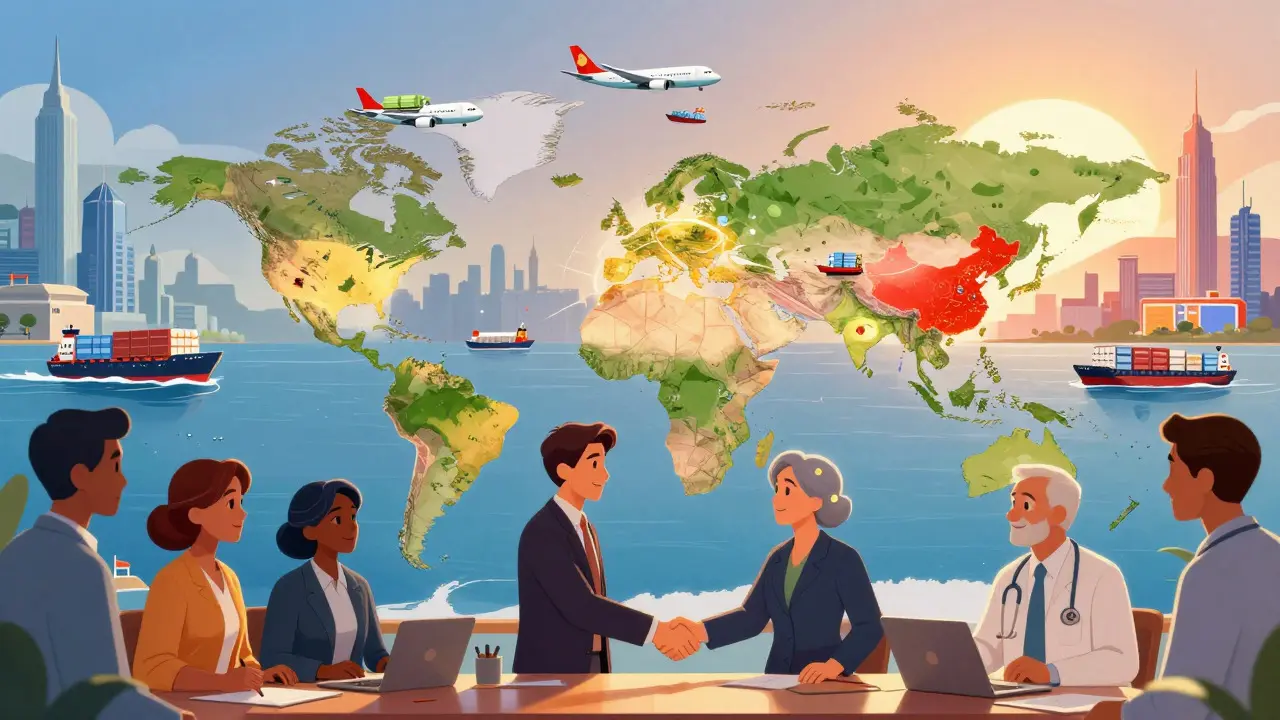
Faced with thin margins and high risks, generic companies are adapting. One major trend is strategic collaboration. Evaluate Pharma reported 37 major partnership announcements in 2024 alone. Multinational brands are teaming up with local firms in pharmerging markets to navigate regulatory hurdles and access local distribution networks. For example, a European generic maker might partner with an Indian firm to handle manufacturing while leveraging the Indian partner's knowledge of local pricing pressures.
Another strategy is vertical integration. Companies are moving backward into API production to secure their supply chains. India's government is supporting this through schemes like the Production Linked Incentive (PLI), which allocated $1.34 billion in 2024 to boost domestic pharmaceutical manufacturing. This reduces dependence on Chinese APIs and strengthens India's position as a self-sufficient hub.
Innovation is also creeping into the generic space. It's not just about copying old drugs anymore. Some companies are focusing on complex generics-drugs that are difficult to formulate, such as extended-release tablets or inhalers. These products face less competition because fewer companies have the technical expertise to produce them. This allows for better pricing and longer market exclusivity.
What Lies Ahead: 2026 to 2030
Looking ahead, the global generic market will continue to grow, but the nature of that growth will change. BCC Research projected the market would reach $655.8 billion by 2028, while ForInsights Consultancy offers a more conservative estimate of $689.56 billion by 2034. Regardless of the exact number, the trajectory is upward. The key drivers remain the same: aging populations, rising chronic diseases, and the need for cost containment.
However, the share of generics within the total pharmaceutical market may decline slightly. Evaluate forecasts that global prescription drug sales will reach $1.7 trillion by 2030, but generic market share could drop from 57.56% in 2024 to around 53% by 2030. Why? Because biologics and specialty drugs, including new GLP-1 obesity treatments, are taking up more space in the pipeline. These drugs are harder to copy and command higher prices.
Yet, generics will remain indispensable. As long as healthcare systems struggle with budget constraints, the demand for affordable alternatives will persist. The companies that thrive will be those that can balance cost efficiency with quality assurance, navigate complex regulatory environments, and invest in the next generation of biosimilars. The era of easy money in generics is over, but the era of strategic, high-value generic manufacturing has just begun.
What is the difference between a generic drug and a biosimilar?
A generic drug is a copy of a small-molecule brand-name drug, made through chemical synthesis. It is structurally identical to the original. A biosimilar is a copy of a biologic drug, which is made from living cells. Because biologics are complex, biosimilars are highly similar but not identical to the reference product. They require more extensive testing and are generally more expensive to develop than traditional generics.
Why are generic drug prices so low compared to brand names?
Generic drugs are cheaper because manufacturers do not bear the initial costs of research and development (R&D) or clinical trials. Once a brand-name drug's patent expires, generic companies can enter the market with minimal R&D investment, competing primarily on price. This competition drives prices down, often by 80-85% compared to the original brand.
Which countries dominate the global generic drug market?
India and China are the dominant players. India is known as the "pharmacy of the world" for its vast production of finished generic dosage forms, supplying about 20% of global volume. China dominates the production of Active Pharmaceutical Ingredients (APIs), providing roughly 65% of the raw materials used in generic drug manufacturing worldwide.
What are "pharmerging" markets?
Pharmerging markets refer to emerging economies with high growth potential in the pharmaceutical sector, such as India, China, Brazil, Russia, and Turkey. These regions are characterized by expanding healthcare infrastructure, increasing insurance coverage, and a growing population of patients with chronic diseases, driving both consumption and manufacturing capabilities.
Are generic drugs as safe and effective as brand-name drugs?
Yes, generic drugs must meet strict regulatory standards to prove they are bioequivalent to brand-name drugs, meaning they work the same way in the body. However, quality control issues can arise, particularly in markets with weaker regulatory oversight. Regulatory bodies like the FDA and EMA continuously monitor manufacturing facilities to ensure safety and efficacy.
How does the expiration of patents affect the generic market?
Patent expirations are the primary driver of generic market growth. When a patent expires, generic manufacturers can legally produce and sell versions of the drug. This leads to increased competition, lower prices, and broader access to medications. Approximately $70 billion in branded drug revenues faced patent loss in 2024 alone, creating significant opportunities for generic competitors.