When you pick up a prescription, you might be handed a pill bottle with a different name than what your doctor wrote. That’s not a mistake. It’s pharmacy substitution-a legal process where your pharmacist swaps a brand-name drug for a cheaper generic version. But here’s the catch: what’s allowed in one state might be illegal in another. If you’ve ever been confused by a different-looking pill, or wondered why your insulin wasn’t switched, you’re not alone. Every state has its own rules, and getting them wrong can cost you money, time, or even your health.
What Exactly Is Pharmacy Substitution?
Pharmacy substitution means your pharmacist gives you a generic version of a drug instead of the brand-name one your doctor prescribed. Generics have the same active ingredients, strength, and dosage form as the brand. They’re just cheaper-often 80% to 85% less. The FDA requires them to be just as safe and effective. But not all drugs can be swapped, and not all states let pharmacists do it without asking you first.There are two main types of drugs involved:
- Small-molecule generics-like metformin for diabetes or atorvastatin for cholesterol. These are chemically identical to their brand names and are the most commonly substituted.
- Biosimilars-these are copies of complex biologic drugs like Humira or Enbrel. They’re not exact copies, but close enough to work the same way. Only a few have been approved as "interchangeable," meaning pharmacists can swap them without a doctor’s permission-but only if your state allows it.
Here’s the reality: 90% of all prescriptions in the U.S. are filled with generics. That’s because they save patients and insurers hundreds of billions a year. But behind that number is a patchwork of state laws that can make switching confusing-or even risky-if you don’t know the rules.
How Do State Laws Differ?
Not all states treat substitution the same. Some force pharmacists to switch. Others say they can, but only if you agree. A few won’t let them swap certain drugs at all.There are three main types of state laws:
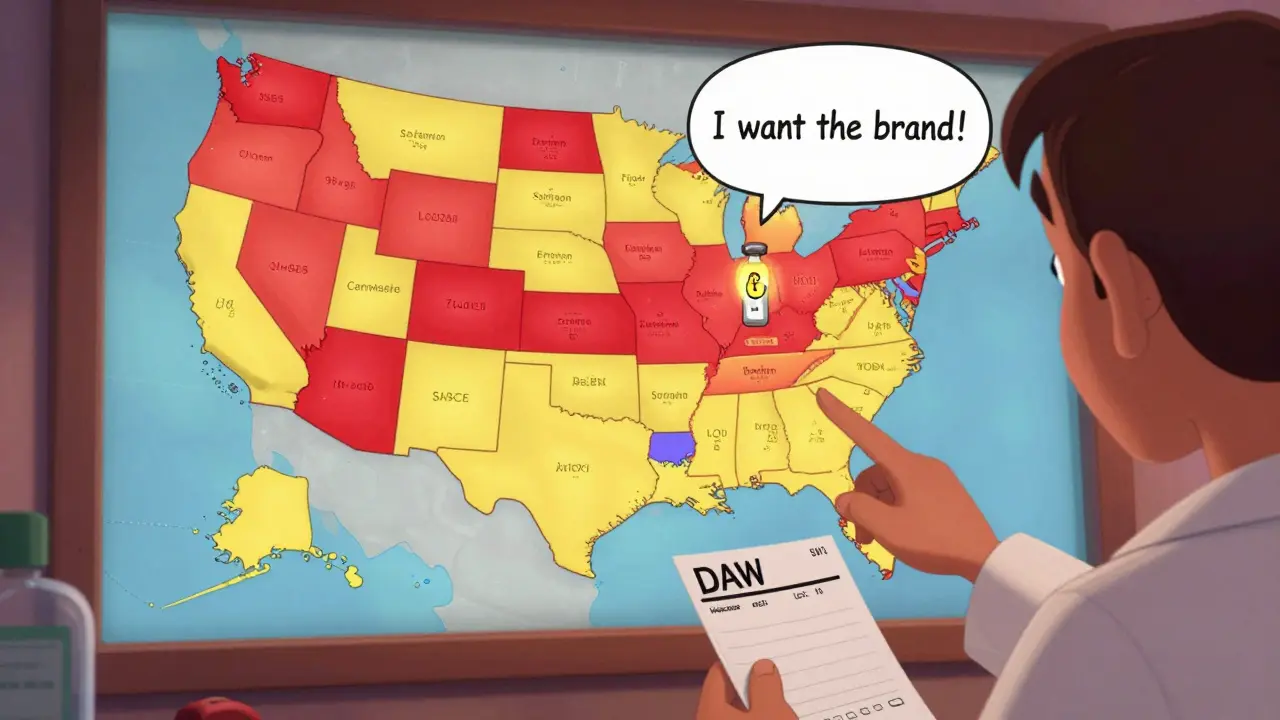
- Mandatory substitution (19 states + D.C.): The pharmacist must substitute unless the doctor says "dispense as written." States like California, New York, and Texas use this model.
- Permissive substitution (31 states + D.C.): The pharmacist can substitute, but only if they tell you first. No consent needed in most cases-just notification.
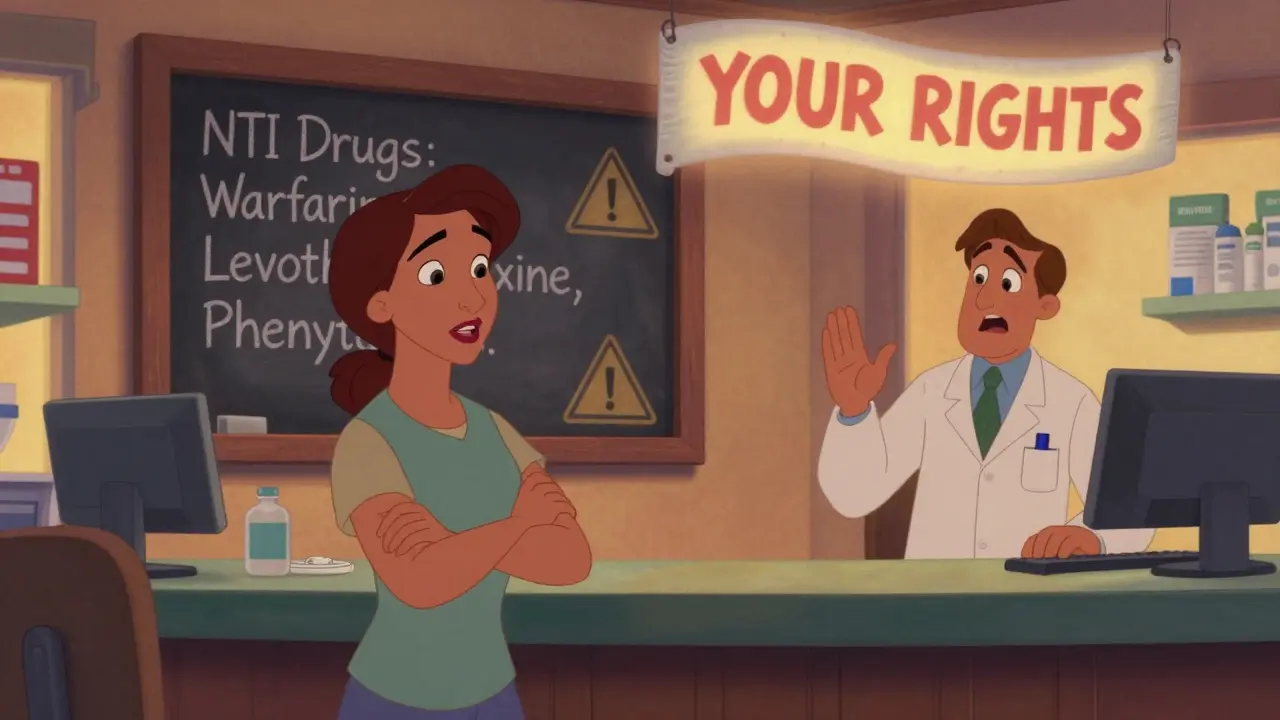
- Restrictive rules: Some states ban substitution for specific drugs, especially those with a narrow therapeutic index (NTI). These are drugs where even tiny differences in dosage can cause harm-like warfarin (blood thinner), phenytoin (seizure control), or levothyroxine (thyroid). In states like Kentucky and Hawaii, pharmacists can’t swap these without explicit approval from your doctor and you.
For example, in Oklahoma, pharmacists can’t substitute unless you or your doctor gives them permission. In Hawaii, they can’t swap antiepileptic drugs without both your and your doctor’s consent. In contrast, in Florida, substitution is routine-unless the doctor blocks it.
What About Biosimilars? It’s Even Trickier
Biosimilars are the new frontier. They’re cheaper versions of expensive biologic drugs used for conditions like rheumatoid arthritis, psoriasis, and cancer. But they’re not as simple to swap.The FDA has a special label: "interchangeable." Only 10 biosimilars had this status as of late 2023. That means they’re proven to work just like the original-no extra risk. But even if a biosimilar is interchangeable, your state still decides if it can be swapped.
Here’s how states handle biosimilar substitution:
- Notification required (37 states): The pharmacist must tell your doctor within 24 to 72 hours after swapping. Some states require you to be notified too.
- Pre-authorization needed (12 states): Your doctor must approve the swap before it happens.
- Cost-based restrictions (15 states): If the biosimilar costs more than the brand, substitution is blocked-even if it’s interchangeable.
California’s law, updated in 2023, now requires pharmacists to notify patients at the counter and send a written notice to the prescriber within 24 hours. New York’s 2023 law expanded substitution rights for certain biosimilars. But in Alabama or Mississippi, the rules are minimal-just basic documentation.
And here’s a big problem: 67% of pharmacists admit they were confused at first about the difference between "biosimilar" and "interchangeable". If they’re unsure, they might not substitute at all-even when it’s legal. That means you might be paying more than you need to, just because the system is messy.
What Can You Do as a Patient?
You’re not powerless. Even if your state allows automatic substitution, you still have rights.- Ask if a generic was substituted. You have the right to know what you’re taking. Don’t assume the pill looks the same because it’s the same drug.
- Ask why. If your doctor wrote "dispense as written," but you got a generic anyway, ask why. That’s a violation of the law.
- Refuse substitution. You can say no-even in states that require substitution. Pharmacists are legally required to honor your request, even if they don’t like it.
- Check your receipt. Most states require the pharmacy to note the substituted product on your receipt or label. Look for the brand name and the generic name side by side.
- Know your NTI drugs. If you take warfarin, levothyroxine, or phenytoin, be extra careful. Don’t let your pharmacist swap these unless you’ve talked to your doctor first.
And here’s a tip: if you move between states, your substitution rights change. A prescription that was automatically swapped in Texas might be blocked in New York. Keep a list of your medications and their generic names. Bring it to your new pharmacy.
What Can Prescribers Do?
Doctors can block substitution by writing "dispense as written" (DAW) on the prescription. But here’s the catch: 28 states require you to give a reason for that block. In states like Illinois or Minnesota, you can’t just write "DAW"-you have to say why. "Patient preference" or "therapeutic equivalence concerns" are common acceptable reasons.If you’re prescribing a drug with a narrow therapeutic index, always write "DAW" or "no substitution." Even if your state allows it, the risk isn’t worth the savings. A 2018 study found that states with NTI restrictions had 18% fewer adverse events.
Also, if you’re prescribing a biologic, know whether the biosimilar is interchangeable. If it’s not, substitution isn’t legal in any state-even if the pharmacist thinks it is.
How to Find Your State’s Rules
You don’t need to memorize 50 different laws. Here’s how to find yours quickly:- Go to your state’s Board of Pharmacy website. Search for "drug product selection law" or "generic substitution rules."
- Use the Cardinal Health Interactive Map (search online). It shows state-by-state rules for biosimilars and generics.
- Call your pharmacy and ask: "What are your state’s rules for substituting [your drug name]?" They’re required to know.
- Check your prescription label. If the generic name is printed next to the brand name, substitution happened.
Most state boards have downloadable PDFs or FAQs. For example, the New York State Board of Pharmacy has a clear guide on substitution for both generics and biosimilars. The Texas Board of Pharmacy posts its rules online with examples.
Why This Matters for Your Health and Wallet
The goal of these laws is simple: save money without risking safety. And they work. Generics save the U.S. healthcare system $313 billion a year. But that savings only happens if the system works right.When substitution is done correctly, patients get the same medicine at a fraction of the cost. When it’s done wrong-without consent, without notice, or with the wrong drug-it can lead to confusion, side effects, or worse.
For example, a patient switching from one brand of levothyroxine to a different generic might experience fatigue or heart palpitations because the inactive ingredients affect absorption. That’s rare, but it happens. That’s why NTI drugs need extra care.
For biosimilars, the stakes are higher. These drugs cost $10,000 to $20,000 a year. A biosimilar might cost $6,500. But if your state requires prior authorization, and your doctor doesn’t know the rules, you might wait weeks for coverage. That’s not just a financial burden-it’s a health risk.
What’s Changing in 2026?
The landscape is shifting. More biosimilars are getting "interchangeable" status. By 2030, biosimilars could make up 70% of the biologics market-if states simplify their rules.The National Association of Boards of Pharmacy is pushing for standardized rules across states. Twenty-two states have already adopted parts of their model legislation, which focuses on:
- Clear notification timelines
- Uniform documentation
- Consistent patient rights
Expect more states to require electronic notifications to prescribers and better labeling on prescriptions. Some may even start requiring pharmacists to ask for consent before swapping biosimilars-even in permissive states.
Bottom line: the rules are getting clearer, but they’re still not the same everywhere. Stay informed. Ask questions. Don’t assume.
Can my pharmacist substitute my brand-name drug without telling me?
In 31 states plus D.C., pharmacists can substitute generics without your permission-but they must notify you after the fact. In 7 states plus D.C., they must get your explicit consent before swapping. In no state can they swap without any notice. Always check your receipt or label for the generic name.
What if I get a different-looking pill and I’m not sure if it’s the same drug?
Call your pharmacy and ask: "Is this a generic version of [brand name]?" All pharmacies are required to confirm this. You can also check the National Library of Medicine’s DrugBank or the FDA’s Orange Book online to compare active ingredients. If the active ingredient is the same, it’s the same drug-even if the shape or color changed.
Can I refuse a generic drug even if my state allows substitution?
Yes. You can refuse substitution in every state. Just tell the pharmacist, "I want the brand name as prescribed." They must honor your request. If they refuse, ask to speak to the manager or contact your state’s Board of Pharmacy. You have the right to choose what you take.
Why can’t my pharmacist swap my insulin for a biosimilar?
Most insulin products are not yet designated as "interchangeable" by the FDA. Even if a biosimilar version exists, pharmacists can’t substitute it unless your state allows it and the product has interchangeable status. As of late 2023, only 10 biosimilars had that status. Check with your pharmacist or prescriber to see if your insulin has an interchangeable version and whether your state permits substitution.
Are generics as safe as brand-name drugs?
Yes. The FDA requires generics to meet the same quality, strength, purity, and stability standards as brand-name drugs. They’re tested to ensure they work the same way in the body. The only differences are in inactive ingredients (like fillers or dyes), which rarely cause problems. For most people, generics are just as safe and effective. But for drugs with narrow therapeutic indices-like warfarin or thyroid meds-small differences can matter. Always talk to your doctor if you’re unsure.